Categories
Europe GDPR Insight Legal & Compliance Strategy and Management UK

Countdown to D-Day: GDPR and affiliate marketing – will you be ready or devastated?

It’s been in the making for more than four years and is coming into force in less than 12 months’ time: GDPR (General Data Protection Regulation) represents the largest change in data protection and privacy rules in more than 20 years. May 25, 2018 is D-Day for the new GDPR regulation, which is designed to harmonise data privacy and protection laws across Europe. Any business that handles, markets to, tracks or creates profiles of EU citizens must comply with the new regulations. Richard Dennys discusses how affiliate marketers and businesses that utilise affiliate marketing can prepare for the GDPR and ensure their websites are compliant.

This content is for Free membership members only.
Register
Already a member? Log in here
Categories
Europe Global In the News Strategy and Management UK Web Analytics

Oh, what a tangled web! Infographic unravels the secrets of internet brand connections

Did you know that Google owns Uber? Or that Microsoft owns LinkedIn and Nokia? You do now . . . although the landscape is changing incredibly quickly.

Hallam Internet – a UK-based provider of digital marketing services – recognised it can be tough to keep tabs on who’s who so, earlier this year, it took on the task of working out the tangled web connections. Hallam has now created the interactive infographic shown below, highlighting some surprising connections between arguably the most popular brands around – many of which marketers across the world use daily.

The Tangled Web – Interactive Infographic links up the brands in the digital space – from eBay to Paypal, Twitter to Soundcloud, showing how the ever-changing online landscape is truly a ‘tangled web’ of connected businesses.

tangled web connectionsSusan Hallam (pictured), managing director at Hallam Internet, told the GMA: “I don’t know how many people appreciate that Google is a major investor in Uber. Or realise that Microsoft owns LinkedIn and Nokia. The web is an incestuous place with tangled relationships. And our digital marketing team decided to research the relationships among the leading digital players, investigating the names we all use on a daily basis.”

Deeper into tangled web connections

She added: “The deeper we dug, the more inter-relationships we discovered. In some cases, these are relationships that were formed in the earlier days, for example when they were still in a start-up phase. Other relationships are more recent, for example LinkedIn purchasing Slideshare. We were also interested to discover the relatively broad range of relationships. Relatively unknown names like IAC have relationships with organisations like Expedia, Hotels.com, as well as Ticketmaster and Match.com

“After gathering the data, we then faced the challenge of programming the interactive infographic so that it legibly displays the complex tangle of inter-relationships. Creating a mobile-friendly version was high on our list of priorities as we knew it would be hugely popular with mobile users. And we’ve created a format that is scalable. We are welcoming suggestions for new relationships to represent on The Tangled Web, and it will be relatively straight-forward for us to add new hubs and nodes.

“Most importantly, we are seeing new relationships forming on nearly a daily basis and we hope to be updating it frequently.”

View the infographic below:

Categories
Data Management Europe Insight Strategy and Management UK

The elephant in the room: it’s time to talk data monetisation

Many consumers remain suspicious about it and even the term ‘data monetisation’ can prompt consumer concern that brands are making money from their personal asset. But it’s time to explain how it all works, how to make ourselves proud of our industry and how, actually, data makes the world go round:

This content is for Free membership members only.
Register
Already a member? Log in here
Categories
Americas Asia-Pacific Data Management Europe Global In the News India Russia Strategy and Management

How can you save your data from cybercriminals?

It was called WannaCry for a good reason and probably more than a few tears were shed – of despair as well as fury – as the latest malware attack became an epidemic, stripping data and locking down computer systems around the world.

We shouldn’t be surprised. Interpol reports that the fastest-growing crime, globally, is cybercrime. In the aftermath of the WannaCry ransomware attack of May 12, the international police organisation’s secretary general, Jürgen Stock, said specialists from its 190-member countries were examining the after-effects while preparing for further threats.

Stock described the investigation into the attack as “complex and globally significant”, adding: “It is essential the full scale and scope of it is established if we are to assist member countries, deliver an effective response and put measures in place to prevent future cyber attacks against critical infrastructures.”

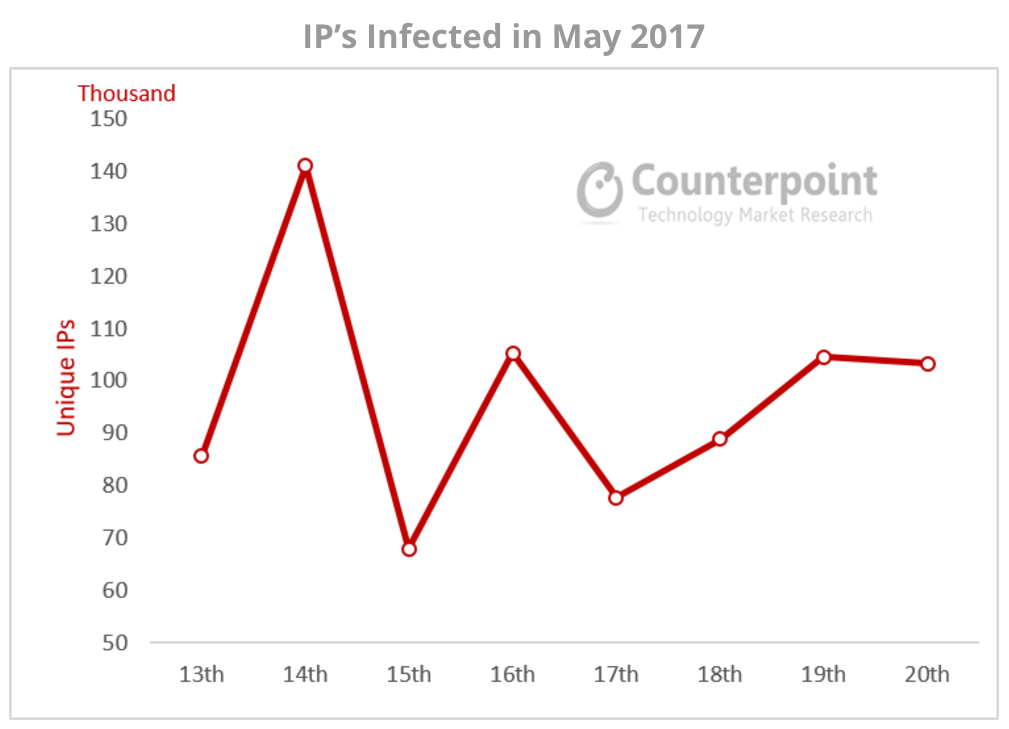
But putting it perhaps more scarily succinctly was IT expert and research analyst for Counterpoint, Satyajit Sinha. He warned that this cyber attack “was not the first and definitely not the last”, adding: “Near term, we expect attacks to target smartphones as well as PCs and IoT devices.”

This particular malware locks an infected computer system and demands a $300 ransom in ‘Bitcoin’ to restore access to files – or face deletion of data. One UK-based IT worker is known to have paid around £70,000 to recover his personal data – there may well be others who have reacted similarly. It’s the newest form of extortion.
cybercriminals

In the first seven days, the WannaCry malware infected more than 130,000 organisations across 150 countries. They included energy companies such as WBSEDC in India, Iberdrola in Spain, Petrobras in Brazil; telecoms – Telefonica, Portugal Telecom, MegaFon and Telenor Hungary; and banks such as Sberbank, Bank of China and Russia Central Bank. And, within two days of the malware crisis, at least 16 hospitals in the UK were forced to divert emergency patients as core equipment was compromised.

The US Department of Defense has said that this year it is updating 4 million computers to Windows 10 – the Pentagon was still using Windows 95 and 98 on several missile control computers. The malware attack – known to target major organisations that are still running software that is out of date – has prompted the DoD to prioritise the move.

Cybercriminals: can you outsmart masters of the dark art?

While the rise of the internet has been a boon for consumers and businesses, it has also opened up this whole new level of criminal activity. A new research report says ever-increasing online connectivity will lead to data breaches that will cost businesses a total of $8trillion over the next five years.

What can we do?

The scenario will be compounded by inadequate enterprise-wide security: big brands and other organisations become vulnerable as old and new IT systems are integrated by tech teams that might have taken their eye off their overall network security, albeit briefly. In other words, computer hackers are swift to spot an unlocked ‘back door’ while the IT guys are busy updating the front door. It’s what hackers are good at – they are highly trained, hugely professional and well funded in their dark art.

If only they were honest . . .

The research, The Future of Cybercrime & Security: Enterprise Threats & Mitigation 2017-2022, forecasts that the number of personal data records stolen by cybercriminals will reach 2.8 billion this year, almost doubling to 5 billion in 2020, in spite of the development of innovative cyber security solutions.

Researchers at Juniper found that SMEs (small and medium enterprises) are especially at risk from cyber attacks, spending less than $4,000 on cyber security measures this year. Only marginal increases in security spend are expected over the next five years. These firms also tend to run older software, which have been exploited by the WannaCry malware and others.

The research points to a need for companies to put more resources into cyber security and system upkeep – treating them as a vital element of workplace safety.

The author of the research, James Moar, said: “The attacks on hospital infrastructure show that inadequate cyber security can now cost lives as well as money. Businesses of all sizes need to find the time and budget to upgrade and secure their systems, or lose the ability to perform their jobs safely, or at all.”

Cyber security expert Giridhara Raam told The GMA that effective data back-up is vital to ensure files are not stripped in a malware attack. He said: “Once ransomware has encrypted your files, there’s little you can do. Having a back-up of your files is the only sure way to restore them. If the ransomware is weak, it can sometimes be hacked to recover the data. But that’s not going to work on a well designed, professional ransomware attack like WannaCry.

Read also:

Under cyber attack: ‘Hello, I’m WannaCry – pay me to decrypt your files’

Web analytics and safeguarding your site in the ‘age of impersonator bots’

Categories
Europe Insight Strategy and Management

Europe: who’s watching the ads? Lifting the veil on ads viewability

What’s the ads viewability situation across Europe and what can marketers do to improve it – to make their ads the ‘stickiest’? How can they optimise their online ad campaigns? Anant Joshi examines in detail what the latest Meetrics statistics reveal.

This content is for Free membership members only.
Register
Already a member? Log in here
Categories
Data Management Data Protection Europe GDPR Global Insight Strategy and Management UK

How do marketers solve the problem of fake data?

A study has found that almost a quarter of consumers have submitted bogus personal details – fake data – in order to access information online anonymously. Which means marketers’ databases could be wildly inaccurate and organisations are wasting resources targeting people or places that actually don’t exist. It’s a situation that will only worsen when the new GDPR comes into force next May. So, what’s the solution?

This content is for Free membership members only.
Register
Already a member? Log in here
Categories
Data Driven Channels Europe Global Insight UK

Insights session highlights marketing to consumers in ‘age of anxiety’

In an age of anxiety (recession, Brexit, Trump), how can brands ‘ride the wave’ of changing consumer behaviour? Using its own data looking into consumer behaviour, Exponential shows that marketers’ initial reaction in times of crisis – to pull an advert – is not necessarily the way forward.

This content is for Free membership members only.
Register
Already a member? Log in here
Categories
Americas Case Studies Data Driven Channels Europe

The richer search: what are ‘attributes’ and which do businesses need to thrive? US & European case studies

How can ‘attributes’ be used to boost local marketing potential? These examples – Berlin and San Francisco locations – show how leveraging business attributes can provide potential consumers with a richer search.

This content is for Free membership members only.
Register
Already a member? Log in here
Categories
Best practice Data Driven Channels Europe Global UK

Keep it real: customer journey research shows human interaction is ‘critical’

Study shows that customers believe live assistance is a necessity: the customer journey research reveals that channel choice and human interaction at key stages will seal the deal when it comes to developing loyalty or even averting defection.

This content is for Free membership members only.
Register
Already a member? Log in here
Categories
Data Driven Channels Europe Global Insight UK

How to filter your brand’s Snapchat marketing strategy successfully

Your social media strategy should be carefully tailored, research shows, because different demographics use multiple channels in unique ways – and a brand which uses the same approach across platforms and age groups is unlikely to get good results. Here’s why certain brands should examine their data and hone a Snapchat marketing strategy to target a particular audience.

This content is for Free membership members only.
Register
Already a member? Log in here