Categories
Americas Asia-Pacific China Europe Global Hong Kong India Insight Japan Malaysia Philippines Singapore Strategy and Management UK USA

Spotlight on the ASEAN region – building new trading relationships

As Brexit continues to cast concern for EU trade, Siddharth Shankar sheds light on the ASEAN region and suggests that companies looking to enjoy a fruitful foreign trade relationship should consider the countries within this increasingly important market, which is welcoming international trade.

This content is for Free membership members only.
Register
Already a member? Log in here
Categories
Africa Americas Asia-Pacific Best practice Data Management Eastern Europe Europe Global India MENA Russia Strategy and Management UK

Why it’s not racist for marketers to treat different ethnic groups differently

Marketers aim to understand all potential customers’ needs, desires and behaviours in order to give them personalised access to their services and goods. So why do they shy away from segmenting minority populations according to ethnic groups, culture and background? Prof Richard Webber says that by ignoring those differences – albeit with noble and non-racist intent – marketers are actually depriving those potential consumers of the benefits of customer experience personalisation.

This content is for Free membership members only.
Register
Already a member? Log in here
Categories
Americas Asia-Pacific Data Management Europe Global In the News India Russia Strategy and Management

How can you save your data from cybercriminals?

It was called WannaCry for a good reason and probably more than a few tears were shed – of despair as well as fury – as the latest malware attack became an epidemic, stripping data and locking down computer systems around the world.

We shouldn’t be surprised. Interpol reports that the fastest-growing crime, globally, is cybercrime. In the aftermath of the WannaCry ransomware attack of May 12, the international police organisation’s secretary general, Jürgen Stock, said specialists from its 190-member countries were examining the after-effects while preparing for further threats.

Stock described the investigation into the attack as “complex and globally significant”, adding: “It is essential the full scale and scope of it is established if we are to assist member countries, deliver an effective response and put measures in place to prevent future cyber attacks against critical infrastructures.”

But putting it perhaps more scarily succinctly was IT expert and research analyst for Counterpoint, Satyajit Sinha. He warned that this cyber attack “was not the first and definitely not the last”, adding: “Near term, we expect attacks to target smartphones as well as PCs and IoT devices.”

This particular malware locks an infected computer system and demands a $300 ransom in ‘Bitcoin’ to restore access to files – or face deletion of data. One UK-based IT worker is known to have paid around £70,000 to recover his personal data – there may well be others who have reacted similarly. It’s the newest form of extortion.
cybercriminals

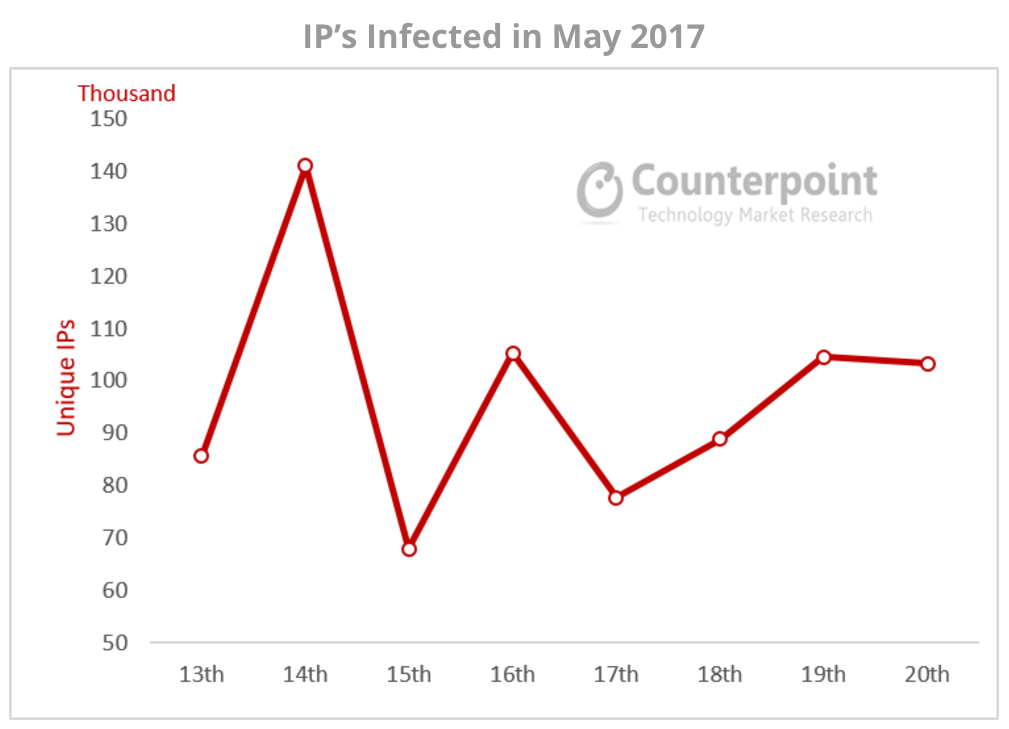
In the first seven days, the WannaCry malware infected more than 130,000 organisations across 150 countries. They included energy companies such as WBSEDC in India, Iberdrola in Spain, Petrobras in Brazil; telecoms – Telefonica, Portugal Telecom, MegaFon and Telenor Hungary; and banks such as Sberbank, Bank of China and Russia Central Bank. And, within two days of the malware crisis, at least 16 hospitals in the UK were forced to divert emergency patients as core equipment was compromised.

The US Department of Defense has said that this year it is updating 4 million computers to Windows 10 – the Pentagon was still using Windows 95 and 98 on several missile control computers. The malware attack – known to target major organisations that are still running software that is out of date – has prompted the DoD to prioritise the move.

Cybercriminals: can you outsmart masters of the dark art?

While the rise of the internet has been a boon for consumers and businesses, it has also opened up this whole new level of criminal activity. A new research report says ever-increasing online connectivity will lead to data breaches that will cost businesses a total of $8trillion over the next five years.

What can we do?

The scenario will be compounded by inadequate enterprise-wide security: big brands and other organisations become vulnerable as old and new IT systems are integrated by tech teams that might have taken their eye off their overall network security, albeit briefly. In other words, computer hackers are swift to spot an unlocked ‘back door’ while the IT guys are busy updating the front door. It’s what hackers are good at – they are highly trained, hugely professional and well funded in their dark art.

If only they were honest . . .

The research, The Future of Cybercrime & Security: Enterprise Threats & Mitigation 2017-2022, forecasts that the number of personal data records stolen by cybercriminals will reach 2.8 billion this year, almost doubling to 5 billion in 2020, in spite of the development of innovative cyber security solutions.

Researchers at Juniper found that SMEs (small and medium enterprises) are especially at risk from cyber attacks, spending less than $4,000 on cyber security measures this year. Only marginal increases in security spend are expected over the next five years. These firms also tend to run older software, which have been exploited by the WannaCry malware and others.

The research points to a need for companies to put more resources into cyber security and system upkeep – treating them as a vital element of workplace safety.

The author of the research, James Moar, said: “The attacks on hospital infrastructure show that inadequate cyber security can now cost lives as well as money. Businesses of all sizes need to find the time and budget to upgrade and secure their systems, or lose the ability to perform their jobs safely, or at all.”

Cyber security expert Giridhara Raam told The GMA that effective data back-up is vital to ensure files are not stripped in a malware attack. He said: “Once ransomware has encrypted your files, there’s little you can do. Having a back-up of your files is the only sure way to restore them. If the ransomware is weak, it can sometimes be hacked to recover the data. But that’s not going to work on a well designed, professional ransomware attack like WannaCry.

Read also:

Under cyber attack: ‘Hello, I’m WannaCry – pay me to decrypt your files’

Web analytics and safeguarding your site in the ‘age of impersonator bots’

Categories
Case Studies India Strategy and Management

Brand awareness campaign that made a connection with millions

How Unilever reached the unreachable and delivered joy to ‘media dark‘ masses in rural India with a unique brand awareness campaign. It’s a marketing story that will touch your heart.

This content is for Free membership members only.
Register
Already a member? Log in here
Categories
China Data Driven Channels Global India Insight UK USA

How to turn your customers into your sales force in the digital economy

There was a day when brands controlled their marketing messages. Not any more. Your marketing is being done for you, even while you sleep. That makes for a very exciting world, a new world and from a marketing perspective. How will you make it work for you?

This content is for Free membership members only.
Register
Already a member? Log in here
Categories
Global In the News India Strategy and Management

Campaign aims to empower girls in rural India

India campaignComputer manufacturer Lenovo has recently launched a campaign on the web called Pitch To Her, to empower rural girls through technology.

Though this is an India-specific campaign, it has seen a lot of interest from organisations and individuals from across the world – such as UN Women, UN Women Australia, Girls Not BridesAdrianne OwingsHalf the Sky Mvmt and Democracy Watch News.

The campaign is bringing to global attention YUWA, a social development platform for girls based in Jharkhand that imparts training in football, provides free education and creates awareness about social evils.

Hailing from the village of Hutup in Jharkhandthe YUWA girls are from a part of society where six out of ten girls are forced to drop out of school and become child brides. The girls came into the limelight on a national level in 2013 by bagging the bronze medal at the Gasteiz Cup in Spain.  In 2014, they were invited to participate in the USA Cup.

This year, the mission taken up by YUWA and Lenovo is to empower the girls with technological knowledge that will propel them towards a smarter world. YUWA India Trust has therefore partnered with Lenovo to launch the national campaign, Pitch to Her, calling the brightest minds in India to enter ideas to ‘hack real world issues’.

Campaign cameras create 360 degree view

As part of the project, the girls are using photography to show the world where they live and what they love.  They are using 360-degree cameras to create a Google Maps Street View of their village: The YUWA girls put their village on Google Street View

Hutup does not even feature on the internet, so the first thing the girls are doing is to create a Wikipedia page, describing local facts and famous places, which they then aim to add to a detailed Wiki entry, along with pictures geo-tagged on the map: YUWA Girls Put Hutup on Wikipedia

While the girls were busy being introduced to and tinkering with technology, Lenovo captured their activity, made content articles and shared them for the world to see and invited the social audience to pitch cool ideas to the girls.

By mid-August, the campaign had led to:

  • Website performance: Generating 1B+ Impressions, 500 pitches, reaching 9 M+ people, a total of 40k visits.
  • Engagement performance: Engagements resulted in 1000+ posts, generating 13M+ Impressions, reaching 8M+ people – in only 3 days!
  • The campaign trended twice on Indian Independence Day, among all the clutter.

This is a strong case of how brands in India and across the globe are moving from baseline to cause or hack marketing and engaging influencers to create real time content. Bhaskar Choudhuri, director, marketing, Lenovo India, said: “We are proud of our association with the YUWA girls. Despite hailing from a small town, they have the required firepower and understand that technology gives them the required platform to achieve their dreams. The primary objective of ‘Pitch to Her’ is to engage young individuals towards empowering the YUWA girls and in a way create an unforgettable, fun experience for these volunteers.”

The campaign ends on September 12.

Categories
Asia-Pacific Data Strategy India Insight Russia Strategy and Management USA

International marketing gone wild!

Columnist Doug Sacks looks beyond the days of BRIC. Mardi Gras is behind us and so the Lenten season is under way. And it is not just drunken college girls in New Orleans who are showing off their assets. Access to mobile phones and mobile phone technologies among the poorest populations are transforming how business…

This content is for Free membership members only.
Register
Already a member? Log in here
Categories
Africa Americas Asia-Pacific Business Analytics Europe India Insight MENA Russia Strategy and Management

Have a ‘MINT’

Did jumping on the BRIC economic bandwagon give you indigestion? Try a MINT. The economist who coined the term BRIC for the powerhouse economies of Brazil, Russia, India and China has done it again. This time it’s the MINT countries of Mexico, Indonesia, Nigeria and Turkey. Doug Sacks wonders if the new term sucks . . .

This content is for Free membership members only.
Register
Already a member? Log in here