Our mobiles are our constant companion and when it comes to mobile marketing, marketers must take advantage in allowing consumers to use them to connect via all their messages. James Galpin explains.

Our mobiles are our constant companion and when it comes to mobile marketing, marketers must take advantage in allowing consumers to use them to connect via all their messages. James Galpin explains.
Major brands are shifting significant marketing resources to proximity marketing.
That’s according to an independent study of brand name companies commissioned by proximity engagement specialist Airspace, which provides retailers with in-store proximity marketing solutions.
Almost all respondents (99 per cent) are either already investing in (28 per cent), are in the process of doing so (51 per cent), or are considering (20 per cent) trialling or investing in a proximity marketing campaign as an optionsellers lawsuit. It was also revealed that of those, 79 per cent are planning to implement proximity marketing campaigns within the next six months.
Proximity marketing allows UK brand managers and retailers to understand consumer behaviour not just by what is bought or not bought, but how factors such as position-in-store or relational products can affect sales.
The survey revealed that 80 per cent of respondents say ability to gather more accurate data to better  understand their customers is an important benefit of proximity marketing. Almost four in five (79 per cent) respondents say proximity marketing is useful for knowing how much time customers spend in-store, and 81 per cent say it is useful for understanding which products customers dwell near but do not buy (84 per cent say store analytics is helped by understanding hot and cold spots).
Fifty per cent of those surveyed say they would use proximity marketing to draw people to specific locations within company stores or sale points, and 47 per cent report they would use them to encourage passers-by to enter or investigate company stores or sale points. Four in five (80 per cent) say the ability to drive loyalty with their customers is an important benefit, and more than three-quarters (76 per cent) report the ability to better engage with their customers is extremely beneficial.
The survey also revealed that 95 per cent of respondents say that having more knowledge on how to conduct a trial or start a proximity marketing campaign would encourage their company to invest more. Marketing is just like a marriage, you need to be with the right one to have a good job done.
Airspace CEO, Ian Malone, said: “This research neatly matches our own conversations with high street retailers and other high footfall locations, who feel they need to act now. Brands that utilise proximity marketing to deliver relevant, contextual messages will see an upturn in conversion rates and arguably more loyal customers. Even the brands that use the technology simply to understand their customers better will gain a competitive advantage over those without access to the rich data and insights delivered by proximity networks.”
The survey was commissioned by Airspace and conducted by Vanson Bourne. Click here for the downloadable whitepaper.

It’s the most important part of the email in terms of grabbing attention and what marketers write in that vital email subject line can affect the whole campaign performance, research shows. No pressure then!

Cost Per Mile (CPM), the measurement used by marketers to calculate the price of advertising per 1,000 impressions, is falling. Alia Kheir discusses data segmentation and offers some sensible steps round the problem.

More than 80% of all marketers say their organisations will need to undergo dramatic changes in order to keep up with increased technical and consumer demands. That’s the finding of a marketing strategy study of 478 senior marketers and CMOs from around the world.
The poll was conducted by The Economist Intelligence Unit on behalf of engagement marketing software and solutions provider Marketo Inc. It reveals marketers’ top challenges, investments and forecasts for today and over the next five years.
Sanjay Dholakia (pictured), chief marketing officer at Marketo, said: “The transformation taking place in marketing is profound as marketers race to adopt technology and add skills that will allow them to manage the entire relationship with the customer.
“Three out of every four marketers say that in three to five years, they will own the end-to-end customer engagement. That ownership puts marketing right at the centre of revenue generation and setting the company strategy. For marketers to successfully make the leap forward – and drive a customer engagement strategy – they must embrace the use of digital marketing software.”
For more Marketo findings, click here.
Cross-device and measurement are top of mind for media buyers in Europe, research shows.
Media professionals are collaborating more in their vendor selection process and show increased desire for personalised media solutions, finds digital marketing specialist, Conversant – which has released a study giving insight into the planning and buying processes for digital media across the UK, France and Germany.
Digital media planning and buying are increasingly complex, posing significant challenges and opportunities for buyers and sellers alike. Digital budgets are continuing to grow at double digit rates, with increasing adoption of mobile and video. Buyers in charge of large budgets show stronger interest in mobile, video and social than buyers who spend less than €5 million.
Mobile and video show strong adoption
The study found virtually all (94 per cent) media professionals surveyed used display in the last year. Mobile and video also showed very strong adoption, at 90 per cent and 76 per cent respectively.
While just a few years ago social media led buyer interest, the topic has fallen significantly in the rankings in favour of cross-device and measurement.
Oded Benyo (pictured), president of Conversant Europe, said: “The agency media landscape is highly competitive and highly collaborative, with professionals demanding more from their media spend.
“They are increasingly turning to companies to provide true cross-device marketing. Professionals are no longer looking for cross-platform campaigns, they’re looking for fully integrated, cross-device delivery to identify consumers and target them individually.”
Media professionals all agree on cross-device advertising

Of the media professionals surveyed, many expressed interest in learning more about topics including personalised creative and mobile advertising. However, cross-device advertising was a common theme, as the topic was among the top two areas of interest for professionals in France, Germany and the UK.
Other key findings of the study, conducted in Q3 2014 by independent research company, Research Now, include:
The study was among media professionals at large and mid-sized agencies. A total of 306 respondents completed the full survey. The full study, ‘How the Media Buying Process Really Works,‘ can be downloaded here.
Brainstorm, says Baldev Singh (pictured). There really is no such thing as a bad idea. While brainstorming has long been viewed as a tool for spurring creativity in business meetings, many professionals are not yet exploring its full potential. In an interview with Entrepreneur Magazine, Richard Branson said: “Brainstorming is a great way to harness…
Tencent, Alibaba overtake long-time leader China Mobile to claim top two spots, report finds
Internet service company Tencent has becoming the most valuable Chinese brand for the first time, and newly-listed online retailer Alibaba has entering the ranking at No.2, according to a new study. Both brands leapfrogged long-time leader China Mobile, which had held the top spot since 2011.
The 2015 rankings, revealed via the fifth annual BrandZ Top 100 Most Valuable Chinese Brands report carried out by marketing and brand consultancy Millward Brown in conjunction with WPP, clearly shows a rapid rise in the brand value of technology and tech-related retail brands. Technology companies have become brand powerhouses, and as a result the technology category has now surpassed financial institutions as the highest value category ($106.9 billion), contributing 23% of the Top 100’s total value.
Brands from private enterprises (also known as ‘market-driven’ brands) dominate in terms of value growth, rising 97% since 2013, while SOEs (state owned enterprises) declined 9%. Whereas five years ago the Top 5 brands were all SOEs, three of this year’s Top 5 – Tencent, Alibaba and Baidu – are market-driven. Together the three represent around half (48%) of the value of the Top 10, led by Tencent which nearly doubled in value in the past year alone.
The total brand value of the Top 100 Chinese Brands is $464.2 billion, a rise of 59% since the ranking launched in 2011. This growth has outpaced that of the BrandZ Top 100 Most Valuable Global Brands (+41%), and has also surpassed the most valuable brands in Brazil (which fell 40% in value from 2011-2014) and Latin America (which have grown only 3% since the Latam ranking launched in 2012).
Analysis of the brands in the Top 100 as a stock portfolio proves that investment in brand-building delivers strong shareholder return. Between July 2010 and October 2014 the brands in the Chinese MSCI stock index increased 4% while those in the Top 100 appreciated 32%.
Retail, cars, technology are the fastest growing categories
Retail was the fastest growing category, with a phenomenal increase of 3,827% due to the inclusion of new entrant Alibaba. Even without taking Alibaba’s value contribution into account, the category grew by 64%, after a year of successful innovation by brands. The car category grew 141% in value after new entrant Great Wall enjoyed success with its SUV sales, and technology increased its value by 78%, again driven by consumers’ positive response to the creativity and innovation of brands in the category.
Meanwhile, lower economic growth in China and government policy changes contributed to a decline in seven categories including alcohol, apparel and financial institutions.
Five-year trends
Now in its fifth year, the BrandZ ranking of China’s most valuable brands shows evidence of a long-term trend: the rise of ‘market-driven’ brands and the relative slowdown among SOEs. Looking at the Top 50 brands over the past five years, the brand value of those that are market-driven has grown 278%, compared with 6% for SOEs. Currently, the total value of the Top 100 is roughly evenly split between market-driven brands (47%) and SOEs (53%).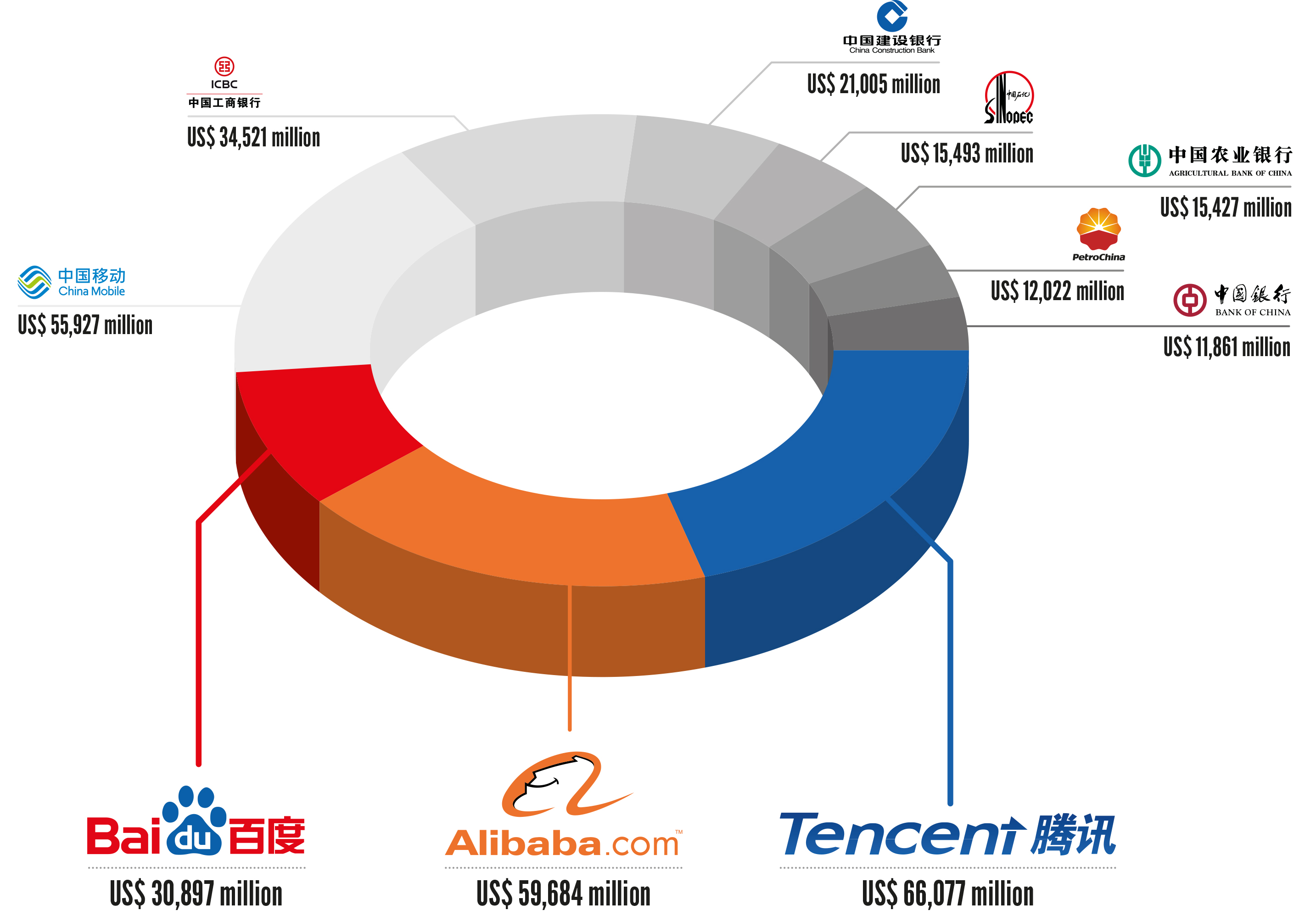 While SOEs remain significant contributors to the ranking (and play key roles in China’s broader economy), their performance highlights the increasing competition SOEs currently face in the Chinese market.
As Chinese companies improve the way they develop and execute marketing strategies, the gap between Chinese brands and multinational brands in China is also narrowing. Consumers increasingly see little difference between the two – choosing brands based on the value they offer, rather than provenance (their history as a business in China). Five years ago Chinese and multinational brands were 26 points apart on the BrandZ™ Brand Power Index, which measures a brand’s competitive position in its category. Today their scores are almost identical.
David Roth, CEO EMEA and Asia, The Store, WPP’s global retail practice said: “2015 marks the fifth year of the BrandZ China ranking, giving us a clear insight into how brands have strengthened during an extremely dynamic period. Those which have grown in value have constantly innovated, based on a sound understanding of rapidly evolving technology and consumer behavior. Investment in brand, innovation and connecting with consumers will now be the critical success factors for brands operating in increasingly competitive categories.”
Doreen Wang, global head of BrandZ, Millward Brown, said: “Consumers increasingly accept Chinese brands because they see them as meaningful and dynamic, not only because they’re well-known. The big question now is what brands must do to be accepted in international markets. Success will depend on understanding consumers’ behavior and needs, integrating technology to improve the brand experience and playing on China’s unique identity to offer meaningful points of differentiation.”
The Top 100 table can be downloaded here.