Drayton Bird examines the front cover of a magazine from the National Trust. It looks beautiful but achieves little. So, what’s the problem? Drayton’s simple diagnosis holds an important lesson for all marketers, whatever their specialist medium.
Drayton Bird examines the front cover of a magazine from the National Trust. It looks beautiful but achieves little. So, what’s the problem? Drayton’s simple diagnosis holds an important lesson for all marketers, whatever their specialist medium.

The reigning heavyweight champion of profit-making copy has provided incisive tips and witty commentary over the past year. Here’s a little Xmas gift featuring some of his wisest words from 2021.

Drayton Bird lauds the value of offering a good freebie to entice people to your product. He explains why it works and offers a prime example courtesy of successful magazine The Oldie.

This article was originally published in Direct Marketing International in 2008. A collection of Herschell Gordon Lewis’ works is available in our free eBook: Killer Copy in a Crisis. Download this treasure trove of timeless marketing advice.
Some advertising agencies may not agree with the philosophy I advocate.
Most direct marketers should agree with the philosophy I advocate.
Just what is that philosophy? Whether your medium is direct mail, newspapers, magazines, television, telephone, or the web, the purpose of your message should be to generate a positive response.
And what is a positive response?
It isn’t a prospective customer or client saying: “I love you.” It’s a prospective customer or client saying: “I want to marry you.”
In clearer terms, it means the message should aim itself at a valid inquiry or an order. ‘Image’, as such, may win the beauty contest; but as an overall criterion of success, image winds up in second place.
 I take issue with the mantra, ‘Marketers are creatively using the internet to raise awareness and affection for their brands.’ No, no, not because the statement is untrue. Rather, it’s because the statement glorifies an apparent waste.
If I’m sending an email on behalf of a television programme or a political candidate or a funeral director, branding and image are logical rationales and copy can exalt to the heavens.
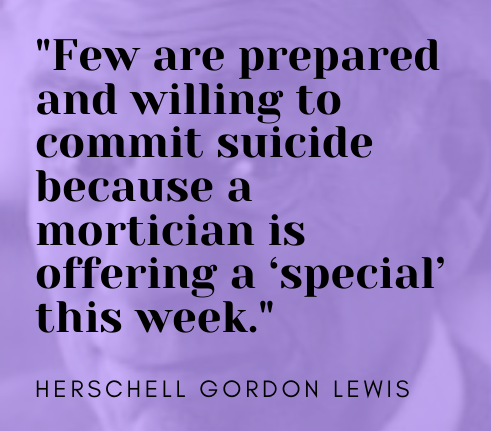
But that isn’t marketing. It’s retention. Tuning to a TV channel and deciding to consider voting for a politician requires some thought but no expenditure of money. And few are prepared and willing to commit suicide because a mortician is offering a ‘special’ this week.
The web, that insatiable science-fiction monster whose cornerstone is emphasis on comparison, is price-driven. I welcome as a competitor anyone whose copy is supposed to offer something for sale and whose copy values image over offer.
Some of the most venerable ‘names’ in the world of commerce are teetering on the edge of insolvency or have toppled over it.
Some of the new hotshots in the world of commerce have leapt into the foreground of their fields because their attention has been to ‘Here’s the deal’ . . . not ‘Here is who we are’.
Back in the antediluvian era – say, 1995 – Web pioneers pointed with glee to their click-through rates.
At the time, that may have been a criterion carrying some validity, because the medium was still in its experimental, embryonic phase and the hypercompetitive era hadn’t yet dawned.
Ah, but that was yesterday. And, as much as we may look backward with nostalgia, we look at our computer screens today with hunger.
Click-through rates are the appetiser, not the main course. Competition in any field we can think of is brutal; and branding, a safe haven for its advocates because comparatively they don’t measure response by actual and countable response, may look superb when comparing design and taglines… but not so superb when comparing bottom lines.
A ‘name’ brand has an implicit advantage going into the arena: People have heard of it.
For the brand to triumph in today’s battle for (to corrupt the famed A E Housman quote) crowns and pounds and guineas, the marketer should use its reputation as a competitive weapon against the inevitable intruders . . . not as a traditional crutch.
Want to sell something to today’s impatient, sceptical, internet-wise consumer or business target?
Your message should answer the inevitable final question: ‘What’s your deal?’
Download our free eBook of Herschell’s marketing wisdom. Guaranteed to entertain and inspire any marketing professional!
Image by Rudy and Peter Skitterians from Pixabay

As email inboxes become increasingly congested, carefully targeted campaigns using direct mail can cut straight through to prospects. Industry pioneer, Nicolas Schwabach, makes the case for direct mail and provides tips on how to do it right and get results.

Herschell Gordon Lewis was never a man to go easy on bad marketing. The late marketing great dissects some of the poorer examples of sales messaging and offers his thoughts on how to avoid the same mistakes.

Copywriting great Drayton Bird recalls one of the finest talks on copywriting he’s ever witnessed. Entitled “20 Opinionated Answers to 20 Questions Nobody Asked,” it’s full of wit and wisdom which is just as relevant today – even if the mediums have evolved. Take away just one lesson and you’re sure to benefit.

Herschell Gordon Lewis tells the story of how he transformed a technical product description into something rather more attractive. He really grabbed this one by the lion’s mane!
It’s easy for marketers to lose sight of what really matters. Creative minds shoot off in all directions, while the plethora of platforms can distract as well as solve. The timeless wisdom of the late Herschell Gordon Lewis ensures you focus your energy where it matters most.

Drayton Bird recently read a guide to email marketing. He wasn’t impressed. In fact, he found it astonishingly bad. A dearth of examples, a torrent of vacuous claims and a scattering of irrelevant imagery. I’m sure you can do better!