Do you ‘optimise’ more than you’d like to think? Are you a regular ‘utiliser’? Then it’s time to kick the habit, says the late great Herschell Gordon Lewis.

Do you ‘optimise’ more than you’d like to think? Are you a regular ‘utiliser’? Then it’s time to kick the habit, says the late great Herschell Gordon Lewis.

Waffles may have a place at the breakfast table, but they have no place in your copy. Especially in the first paragraph! Drayton Bird offers childishly simple advice that we adults too often overlook.

Rosser Reeves was an advertising titan from a dim and distant past. The late great Herschell Gordon Lewis reveals the timeless lesson all direct marketers should learn from him. (Note: this article is an excerpt from our eBook featuring a collection of Herschell’s works.)

In a new series of blog posts, we examine how companies are utilising direct marketing around the globe. We pull out key techniques, good and bad practice, and highlight important lessons we could all learn.
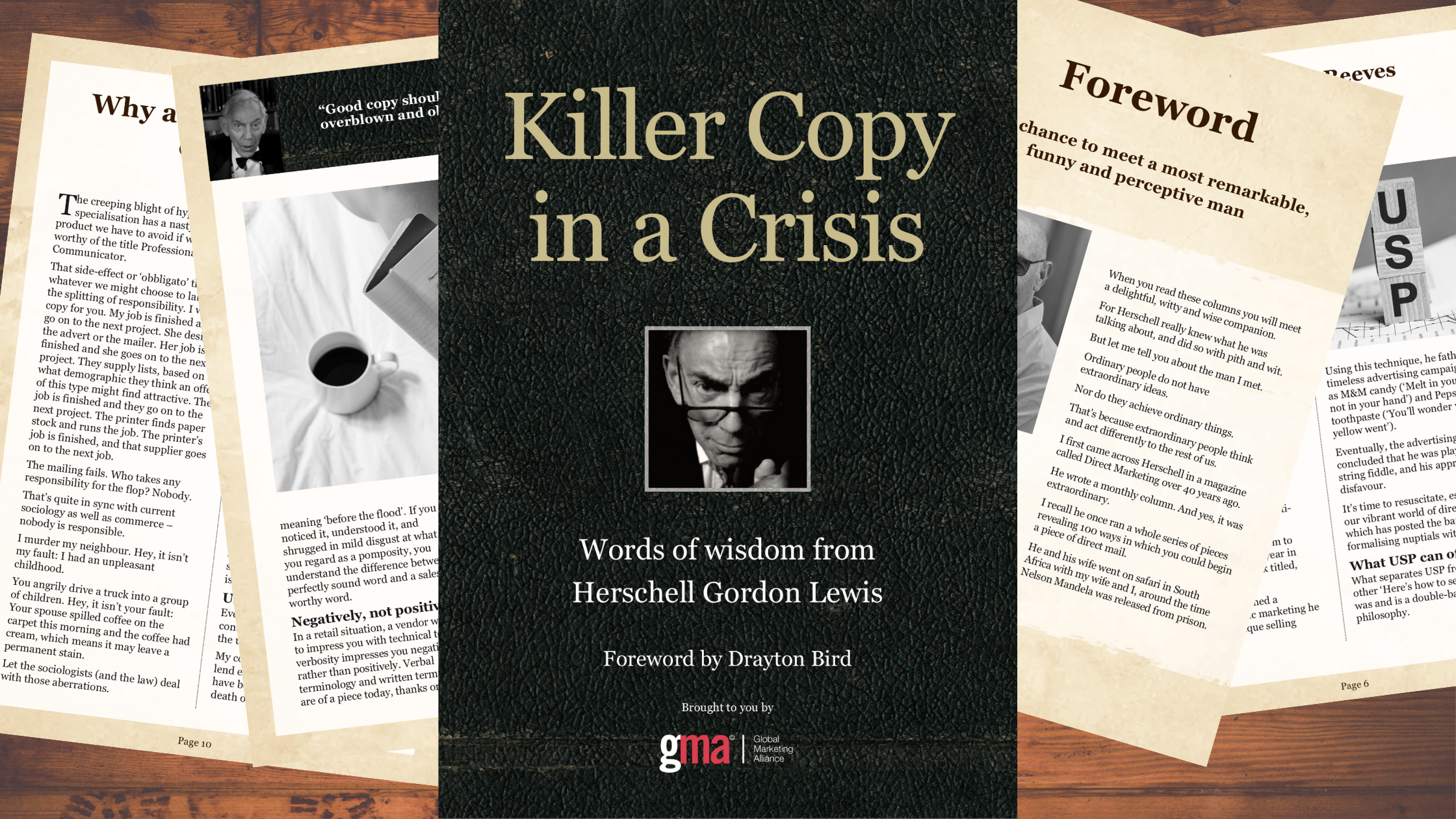
Delve into the works of the late great Herschell Gordon Lewis, AKA ‘The King of Killer Copy’ and discover how to create copy that sells even during the most challenging times.
But the international direct marketing community knew him better as the King of Killer Copy.
Herschell Gordon Lewis was a professor of English who made words his weapon of choice and taught marketers how to use them skilfully by ‘poking ’em directly so they wouldn’t forget ’em.’
Herschell published over thirty copywriting books including Hot Appeals or Burnt Offerings, Sales Letters That Sizzle, and Open Me Now.
For many years he wrote a monthly column called Copy Class for Direct Marketing International magazine (now the Global Marketing Alliance).
Killer Copy in a Crisis is an exclusive collection of Herschell’s articles published from 2008 – 2010.
Twelve years ago, Herschell was writing about the importance of innovative marketing in a financial crisis. Not this one, the last one.
The Foreword is written by one of the UK’s most well-known marketing experts, Drayton Bird.
David Ogilvy said of him “Drayton Bird knows more about direct marketing than anyone in the world”.
When asked if he’d like to contribute, Drayton kindly agreed by saying: ‘Herschell was a one-man oasis of wit in a desert of bores’
Killer Copy in a Crisis is must-read for anyone with the word marketing in their job title.

Over the next few weeks, we’ll be bridging the gap between data insight and effective action.
Once described by David Ogilvy as knowing “more about direct marketing than anyone in the world”, Drayton shares his exclusive straight-shooting wisdom right here on the GMA.
He reminds us all of what really matters: persuasive copy that gets results.

Are you using a real-time conversational channel – the live chat facility – for your visitor’s journey through your website? Marie Sagarzazu discusses when to use it for best effect and how it can enhance or hinder the customer experience. Make sure you can spot the difference and act accordingly.

All digital marketers are becoming direct marketers. So says Phil Andrews here, as he examines the evolution of what he calls Direct Marketing 4.0 and decides that a combination of digital and direct disciplines are the way forward – a collaboration that will drive effective use of tight marketing budgets, win engaged consumers and increase sales. It’s a future where great creative is driven by insight and data.

Dubbed ‘Direct Marketing 4.0’ and ‘Data Directed Marketing’, smarter data insight is achievable if you follow that modern approach, says Phil Andrews. Here, he describes the process required to take advantage of real-time digital markets; combining the depth and rigour of direct marketing with the reach, personalisation and real-time dynamic approach of digital.

A study has found that almost a quarter of consumers have submitted bogus personal details – fake data – in order to access information online anonymously. Which means marketers’ databases could be wildly inaccurate and organisations are wasting resources targeting people or places that actually don’t exist. It’s a situation that will only worsen when the new GDPR comes into force next May. So, what’s the solution?