Categories
Asia-Pacific Case Studies Data Management Europe Global Japan Netherlands Strategy and Management

Pedal to the metal — bringing the Mazda customer journey to life (case study)

We are currently witnessing a period of immense change within marketing, says Anoma van Eeden. Consumers are far more aware of the ways in which brands are communicating with them and more savvy in determining and dictating their own customer experience – so here’s how the Mazda customer journey was made unique to the individual, bringing a fully connected and personalised experience.

This content is for Free membership members only.
Register
Already a member? Log in here
Categories
Data Management Global Insight Strategy and Management

The data scientist, examined – addressing the talent gap in data analytics

It is now generally agreed that the process of analysing data is key to successful marketing. Collecting data from happy and consenting customers is fine, but putting that data to good use – identifying trends, optimising campaigns and examining effectiveness in detail – is still a skill that many marketing departments lack. How skilled is your data scientist? …What’s that? You don’t have one, just a regular marketer trying to keep all the balls in the air (and dropping a few)? Find out why the science of data is so important – as is the need to fill that specific role.

This content is for Free membership members only.
Register
Already a member? Log in here
Categories
Americas Data Management Global Insight Strategy and Management USA

Mature companies: what data do you need and how do you get it?

Marketing consultant Robert Howells presents the third and final part of his series of articles looking at data strategy and business goals. He has traced businesses from start-up (and discussed data quality being more valuable than quantity), through SMB (examining analytics and scale) and now looks at more established businesses – mature companies’ data and what they should being doing with it as a tactical asset.

This content is for Free membership members only.
Register
Already a member? Log in here
Categories
Data Management Insight Strategy and Management

Online marketing science – changing billboards to banners isn’t enough

Technology has created a new era for marketers, says Pini Yakuel. But the move from traditional media to the web is not as simple as putting ads online – they must be carefully targeted so as not to bombard and provoke the viewer into deploying ad-blockers and shifting their loyalty elsewhere. Customer data should be carefully individualised and detailed, segmented into specific personas; the art of advertising has morphed into the online marketing science of data analytics.

This content is for Free membership members only.
Register
Already a member? Log in here
Categories
Americas Data Management Global Insight Strategy and Management USA

SMBs: what data do you need and how do you get it?

A database is like a garden – it needs continual attention, says Robert Howells. Here, he presents part 2 of his series of articles looking at data strategy and business goals. This one examines requirements for growth of small and mid-size businesses and those SMBs data needs.

This content is for Free membership members only.
Register
Already a member? Log in here
Categories
Africa Americas Asia-Pacific Best practice Data Management Eastern Europe Europe Global India MENA Russia Strategy and Management UK

Why it’s not racist for marketers to treat different ethnic groups differently

Marketers aim to understand all potential customers’ needs, desires and behaviours in order to give them personalised access to their services and goods. So why do they shy away from segmenting minority populations according to ethnic groups, culture and background? Prof Richard Webber says that by ignoring those differences – albeit with noble and non-racist intent – marketers are actually depriving those potential consumers of the benefits of customer experience personalisation.

This content is for Free membership members only.
Register
Already a member? Log in here
Categories
Americas Best practice Data Management Global Strategy and Management USA

A faster path to ‘Yes’: using engagement science to move prospects to customers

Data analytics can help identify the right contacts in the right accounts – but newer forms of predictive analytics, combined with sales and marketing data, can help gain an even deeper understanding, enabling companies to identify those who are in the market to buy. Engagement science transforms a one-size-fits-all sales cycle to an individualised approach that will develop sustainable relationships with customers.

This content is for Free membership members only.
Register
Already a member? Log in here
Categories
Data Management Global Insight Strategy and Management

Report: agencies using DMPs to serve clients, win new business

From basic targeting to more refined insight gathering and knowledge sharing, how can agencies provide their clients with an advanced data strategy? A new, global report shows how media agencies are making the most of the capabilities of their DMPs – data management platforms – and highlights regional variations.

This content is for Free membership members only.
Register
Already a member? Log in here
Categories
Data Management Europe Insight Strategy and Management UK

The elephant in the room: it’s time to talk data monetisation

Many consumers remain suspicious about it and even the term ‘data monetisation’ can prompt consumer concern that brands are making money from their personal asset. But it’s time to explain how it all works, how to make ourselves proud of our industry and how, actually, data makes the world go round:

This content is for Free membership members only.
Register
Already a member? Log in here
Categories
Americas Asia-Pacific Data Management Europe Global In the News India Russia Strategy and Management

How can you save your data from cybercriminals?

It was called WannaCry for a good reason and probably more than a few tears were shed – of despair as well as fury – as the latest malware attack became an epidemic, stripping data and locking down computer systems around the world.

We shouldn’t be surprised. Interpol reports that the fastest-growing crime, globally, is cybercrime. In the aftermath of the WannaCry ransomware attack of May 12, the international police organisation’s secretary general, Jürgen Stock, said specialists from its 190-member countries were examining the after-effects while preparing for further threats.

Stock described the investigation into the attack as “complex and globally significant”, adding: “It is essential the full scale and scope of it is established if we are to assist member countries, deliver an effective response and put measures in place to prevent future cyber attacks against critical infrastructures.”

But putting it perhaps more scarily succinctly was IT expert and research analyst for Counterpoint, Satyajit Sinha. He warned that this cyber attack “was not the first and definitely not the last”, adding: “Near term, we expect attacks to target smartphones as well as PCs and IoT devices.”

This particular malware locks an infected computer system and demands a $300 ransom in ‘Bitcoin’ to restore access to files – or face deletion of data. One UK-based IT worker is known to have paid around £70,000 to recover his personal data – there may well be others who have reacted similarly. It’s the newest form of extortion.
cybercriminals

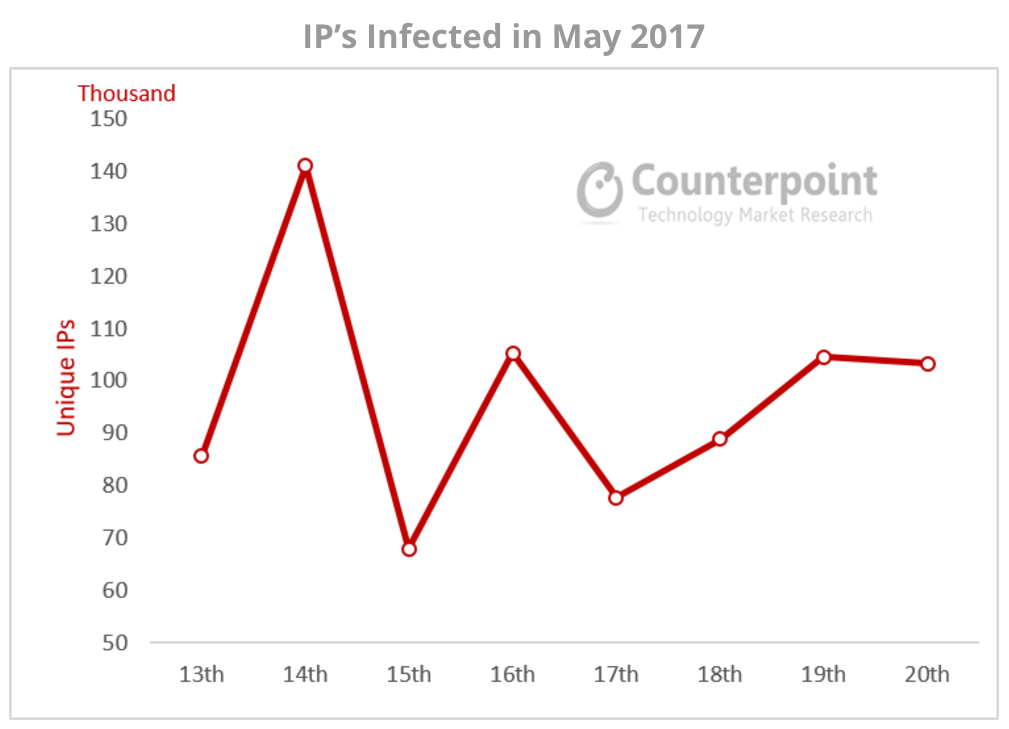
In the first seven days, the WannaCry malware infected more than 130,000 organisations across 150 countries. They included energy companies such as WBSEDC in India, Iberdrola in Spain, Petrobras in Brazil; telecoms – Telefonica, Portugal Telecom, MegaFon and Telenor Hungary; and banks such as Sberbank, Bank of China and Russia Central Bank. And, within two days of the malware crisis, at least 16 hospitals in the UK were forced to divert emergency patients as core equipment was compromised.

The US Department of Defense has said that this year it is updating 4 million computers to Windows 10 – the Pentagon was still using Windows 95 and 98 on several missile control computers. The malware attack – known to target major organisations that are still running software that is out of date – has prompted the DoD to prioritise the move.

Cybercriminals: can you outsmart masters of the dark art?

While the rise of the internet has been a boon for consumers and businesses, it has also opened up this whole new level of criminal activity. A new research report says ever-increasing online connectivity will lead to data breaches that will cost businesses a total of $8trillion over the next five years.

What can we do?

The scenario will be compounded by inadequate enterprise-wide security: big brands and other organisations become vulnerable as old and new IT systems are integrated by tech teams that might have taken their eye off their overall network security, albeit briefly. In other words, computer hackers are swift to spot an unlocked ‘back door’ while the IT guys are busy updating the front door. It’s what hackers are good at – they are highly trained, hugely professional and well funded in their dark art.

If only they were honest . . .

The research, The Future of Cybercrime & Security: Enterprise Threats & Mitigation 2017-2022, forecasts that the number of personal data records stolen by cybercriminals will reach 2.8 billion this year, almost doubling to 5 billion in 2020, in spite of the development of innovative cyber security solutions.

Researchers at Juniper found that SMEs (small and medium enterprises) are especially at risk from cyber attacks, spending less than $4,000 on cyber security measures this year. Only marginal increases in security spend are expected over the next five years. These firms also tend to run older software, which have been exploited by the WannaCry malware and others.

The research points to a need for companies to put more resources into cyber security and system upkeep – treating them as a vital element of workplace safety.

The author of the research, James Moar, said: “The attacks on hospital infrastructure show that inadequate cyber security can now cost lives as well as money. Businesses of all sizes need to find the time and budget to upgrade and secure their systems, or lose the ability to perform their jobs safely, or at all.”

Cyber security expert Giridhara Raam told The GMA that effective data back-up is vital to ensure files are not stripped in a malware attack. He said: “Once ransomware has encrypted your files, there’s little you can do. Having a back-up of your files is the only sure way to restore them. If the ransomware is weak, it can sometimes be hacked to recover the data. But that’s not going to work on a well designed, professional ransomware attack like WannaCry.

Read also:

Under cyber attack: ‘Hello, I’m WannaCry – pay me to decrypt your files’

Web analytics and safeguarding your site in the ‘age of impersonator bots’