Categories
Big Data Data Innovation Global Insight

Big data analytics and mobile technologies ‘redefining the future of digital’

What is big data? Simply put, it refers to an extremely large set of information, and by association its growth and availability, and its implied subsequent usage. We have never previously lived in a world where we have such a potential to share information about ourselves and mine information about others; their thoughts and feelings, their buying and voting habits; their likes and dislikes; and the amount of time spent on each of these things.

This content is for Free membership members only.
Register
Already a member? Log in here
Categories
Data Driven Channels Europe Global In the News Mobile UK

UK: farewell cash and cards, my mobile will pay

Research from Visa Europe reveals that UK mobile payments are projected to hit some £1.2bn a week by 2020, with six in ten expecting to use their mobile devices in the UK for payments at least once a week in the next five years.

The average shopper reckons they will spend £27 via mobile each week by 2020, £10 more than today, and nearly a quarter predict they will spend around £50 a week using their mobile by 2020.mobile phone payment
While apps and music are still the items purchased most frequently via mobile devices now, Visa has seen an increasing number of consumers already buying higher-ticket items, with electronics (23%) and clothes (22%) among their top-five most bought m-commerce items.

Payments via mobile

The British embrace of digital payments is a sign of shoppers’ growing comfort with new methods to pay as they become more widely available, easier to use and better understood. With the increasing publicity around m-commerce options, digital wallets and contactless payments, 43% of shoppers say they would be interested in using a mobile wallet service and nearly half (47%) are interested in using their smartphone to make everyday contactless payments in a shop.

Jeremy Nicholds (pictured), executive director for mobile, Visa Europe, said: “While we’re excited to see consumers saying they expect to triple their weekly spend using mobile payments over the next five years, we at Visa think those VisaEuropenumbers could be rather conservative and that the actual adoption rate will be much higher.

“This is particularly true when you look at the growth in contactless usage, which saw European usage grow by 2x and spend grow by 3x over the last 12 months.

“Contactless and online commerce enhancements have been key in paving the way for the next generation of mobile payment technology. The environmental conditions are already in place to meet the demands and expectations for digital payments.

“It’s no longer a question of ‘if’ consumers will embrace this new way to pay – it’s when – and for us the next 12 months are when mobile payments become mainstream.”

People who are already using their mobile devices to make transactions are also open to other mobile money services. The research highlights that these ‘mobile money’ users are five times more likely to be interested in paying friends through a smartphone app compared to non-users (48% vs. 9%). One in five would be open to social media payments too, compared with only one in twenty non-users.

When looking at the main concerns about mobile payments, a third of respondents admitted that they simply didn’t know enough about it. As with other new technologies, this has resulted in apprehension about issues like privacy, fraud and security.

Nicholds continued: “We’re witnessing a huge surge in interest from consumers in the UK for faster and more convenient payment methods as mobile and online commerce technologies continue to evolve at pace. This is why Visa Europe spends more than €200 million in on innovation including a number of secure payment technologies such as tokenisation to address security and convenience.

“When it comes to money, concerns over control and security are understandable though a simple lack of knowledge is often an underlying cause and consumers are quick to see the benefits of convenience. We’ve seen this with contactless card adoption – once people learn about the technology, see others using it and get used to paying with it, usage soars.”


Categories
Best practice Data Driven Channels Global

Top takeaways for driving customer experience success

Organisations are now challenged with customer’s expectations of delivering impeccably integrated customer experiences on a global scale, through every touchpoint. Paige O’Neill discusses the customer experience (CX).

This content is for Free membership members only.
Register
Already a member? Log in here
Categories
Data Driven Channels Global Next Practice

Spice up your marketing by implementing gamification

A couple of years ago, gamification was the latest craze, everyone was talking about it, but no-one was quite sure how it worked or whether it would become a worthwhile strategy for marketing with measurable ROI. Now, you can add an element of fun into your campaign, says James Burr.

This content is for Free membership members only.
Register
Already a member? Log in here
Categories
Europe Insight UK

Brag a little to boost your brand: harness example of social media

The London School of Marketing (LSM) has published insights on the ways in which social media has contributed to the rise of brag culture in marketing. The article by LSM – which offers accredited marketing and business qualifications in the UK capital – asks the question: in today’s frenzied world of digital marketing, how else can marketers…

This content is for Free membership members only.
Register
Already a member? Log in here
Categories
Data Strategy Insight Strategy and Management USA

Data and tech ‘converging across marketing industry’

“Building on the robust appetite for investment in the marketing services community, this convergence will drive substantial growth and value for marketers and the broad range of solutions providers that support them.”

This content is for Free membership members only.
Register
Already a member? Log in here
Categories
Data Driven Channels Europe In the News UK

Social media tracker shows UK supermarkets in ‘David and Goliath’ battle

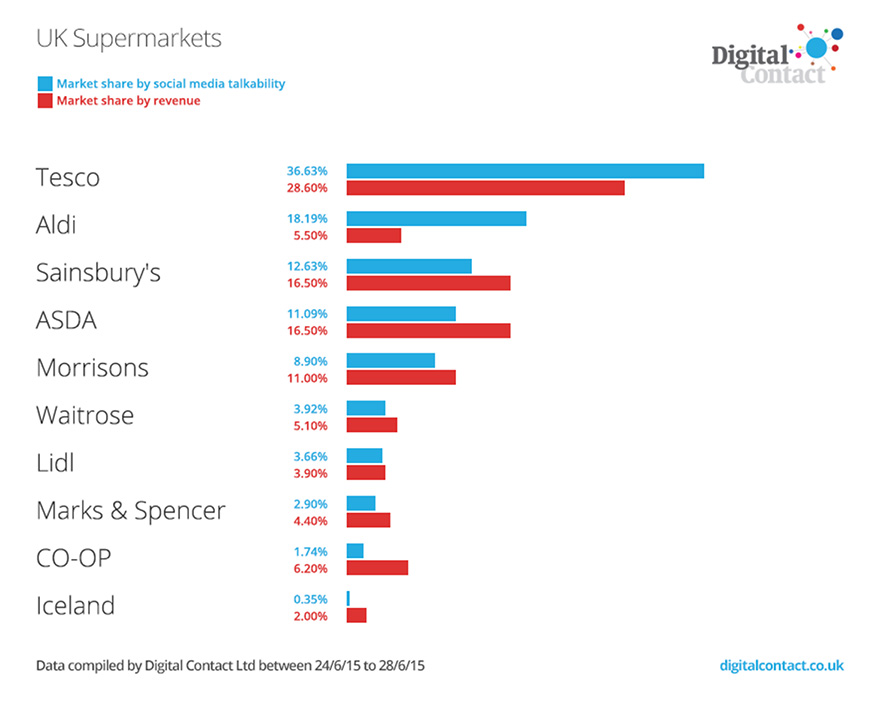
Supermarkets Aldi and Tesco are in a David and Goliath fight for share of voice on social media in the UK, based on their relative market share, according to a ‘Talkability Tracker’ from big data product company DigitalContact.co.uk, which monitored millions of social media mentions during June.

Aldi is becoming the talk of the town on social and taking on Tesco for the top spot in this first supermarket online Talkability Tracker.

DigitalContact.co.uk has developed a snapshot view of the most talked about supermarkets online via analysis which ran for a five-day period between June 24 and 28 and found that Tesco – by far the biggest food retailer in the UK based on market share – topped the conversation list of supermarkets’ online presence. However, of the tweets, 15% of those received were negative, which was 73% higher than average – akin to the incident caused by their placing of Bacon flavoured Pringles in the Ramadan offer, a forbidden food for Muslims.

However, Aldi is getting value for money from its social presence, securing 17% of market share based on social conversations – despite only commanding 5.5% of market share by UK revenue. Aldi has been encouraging positive conversations about their brand by using #AldiChallenge, promoted using the hashtag to report any savings they have made by shopping there. The tracker shows that, if you take into account Aldi’s smaller market share, it is punching far above its weight, outperforming its giant rival by a factor of 2.3x. If you only look at positive mentions, the challenger is doing even better, beating Tesco hands down by a factor of 2.8x.

Social media tracker shows ASDA outshining retailers

As for other supermarket competitors, ASDA is also outshining a number of high street and traditional British retailers, featuring fourth on Digital Contact’s sentiment report, ahead of Waitrose and Marks & Spencer.

It is important to acknowledge that this data is a five day ‘snapshot’ of the most talked about supermarket brands on social media, only taking into account what their customers are saying about them, rather than the conversation they are building themselves. Despite only showcasing a short period, the research reinforces the changeable and powerful impact that conversations had by customers online can have on a brand.

Snapshot of retailers share of social media voiceDigital Contact CEO, Gareth Mann (pictured left), said: “Social media is the voice of the consumer and companies need to be listening to what it says if they want to stay one step ahead. Understanding what has been said about your brand should be paramount to any organisation. This calibre and depth of analysis can help businesses establish a better relationship with customers, understand consumer needs, see the differing trends from around the world and help predict future trends in their industry.

“As we can see, social media is making the fight for brand recognition a level playing field and, by understanding and capitalising on social media, many brands can take on the Goliaths in their markets.”Supermarket battle


Categories
Europe In the News Insight UK

City sales and marketing roles jump 64%, year-on-year

Demand for sales and marketing professionals outstrips supply with 1.6 jobs per candidate In the UK, the number of advertised roles for sales and marketing professionals in the City jumped by 64% in May, compared to last year’s figure. The results of the Robert Walters City Jobs Index, which tracks the number of jobs available and…

This content is for Free membership members only.
Register
Already a member? Log in here
Categories
Data Driven Channels Email Global Next Practice

Email marketing automation is the future, yet 4 in 10 programmes fail

Jennifer Watkiss says marketers should make the time to make timely and relevant communications. Here, she examines the findings of a ninth annual report, surveying more than 1,000 in-house and agency marketers.

This content is for Free membership members only.
Register
Already a member? Log in here
Categories
Case Studies Europe Strategy and Management

Mobile marketing strategy: nobody shops for groceries using a phone – they will now, in Portugal!

We buy most of our groceries at the supermarket. Very few buy them online and those who do rarely use a smartphone. That changes in Portugal this week, where El Cortes Ingles launched a mobile grocery-shopping platform powered by Grability, a New York City-based tech company.

This content is for Free membership members only.
Register
Already a member? Log in here