Our mobiles are our constant companion and when it comes to mobile marketing, marketers must take advantage in allowing consumers to use them to connect via all their messages. James Galpin explains.

Asia-Pacific
Our mobiles are our constant companion and when it comes to mobile marketing, marketers must take advantage in allowing consumers to use them to connect via all their messages. James Galpin explains.
Tencent, Alibaba overtake long-time leader China Mobile to claim top two spots, report finds
Internet service company Tencent has becoming the most valuable Chinese brand for the first time, and newly-listed online retailer Alibaba has entering the ranking at No.2, according to a new study. Both brands leapfrogged long-time leader China Mobile, which had held the top spot since 2011.
The 2015 rankings, revealed via the fifth annual BrandZ Top 100 Most Valuable Chinese Brands report carried out by marketing and brand consultancy Millward Brown in conjunction with WPP, clearly shows a rapid rise in the brand value of technology and tech-related retail brands. Technology companies have become brand powerhouses, and as a result the technology category has now surpassed financial institutions as the highest value category ($106.9 billion), contributing 23% of the Top 100’s total value.
Brands from private enterprises (also known as ‘market-driven’ brands) dominate in terms of value growth, rising 97% since 2013, while SOEs (state owned enterprises) declined 9%. Whereas five years ago the Top 5 brands were all SOEs, three of this year’s Top 5 – Tencent, Alibaba and Baidu – are market-driven. Together the three represent around half (48%) of the value of the Top 10, led by Tencent which nearly doubled in value in the past year alone.
The total brand value of the Top 100 Chinese Brands is $464.2 billion, a rise of 59% since the ranking launched in 2011. This growth has outpaced that of the BrandZ Top 100 Most Valuable Global Brands (+41%), and has also surpassed the most valuable brands in Brazil (which fell 40% in value from 2011-2014) and Latin America (which have grown only 3% since the Latam ranking launched in 2012).
Analysis of the brands in the Top 100 as a stock portfolio proves that investment in brand-building delivers strong shareholder return. Between July 2010 and October 2014 the brands in the Chinese MSCI stock index increased 4% while those in the Top 100 appreciated 32%.
Retail, cars, technology are the fastest growing categories
Retail was the fastest growing category, with a phenomenal increase of 3,827% due to the inclusion of new entrant Alibaba. Even without taking Alibaba’s value contribution into account, the category grew by 64%, after a year of successful innovation by brands. The car category grew 141% in value after new entrant Great Wall enjoyed success with its SUV sales, and technology increased its value by 78%, again driven by consumers’ positive response to the creativity and innovation of brands in the category.
Meanwhile, lower economic growth in China and government policy changes contributed to a decline in seven categories including alcohol, apparel and financial institutions.
Five-year trends
Now in its fifth year, the BrandZ ranking of China’s most valuable brands shows evidence of a long-term trend: the rise of ‘market-driven’ brands and the relative slowdown among SOEs. Looking at the Top 50 brands over the past five years, the brand value of those that are market-driven has grown 278%, compared with 6% for SOEs. Currently, the total value of the Top 100 is roughly evenly split between market-driven brands (47%) and SOEs (53%).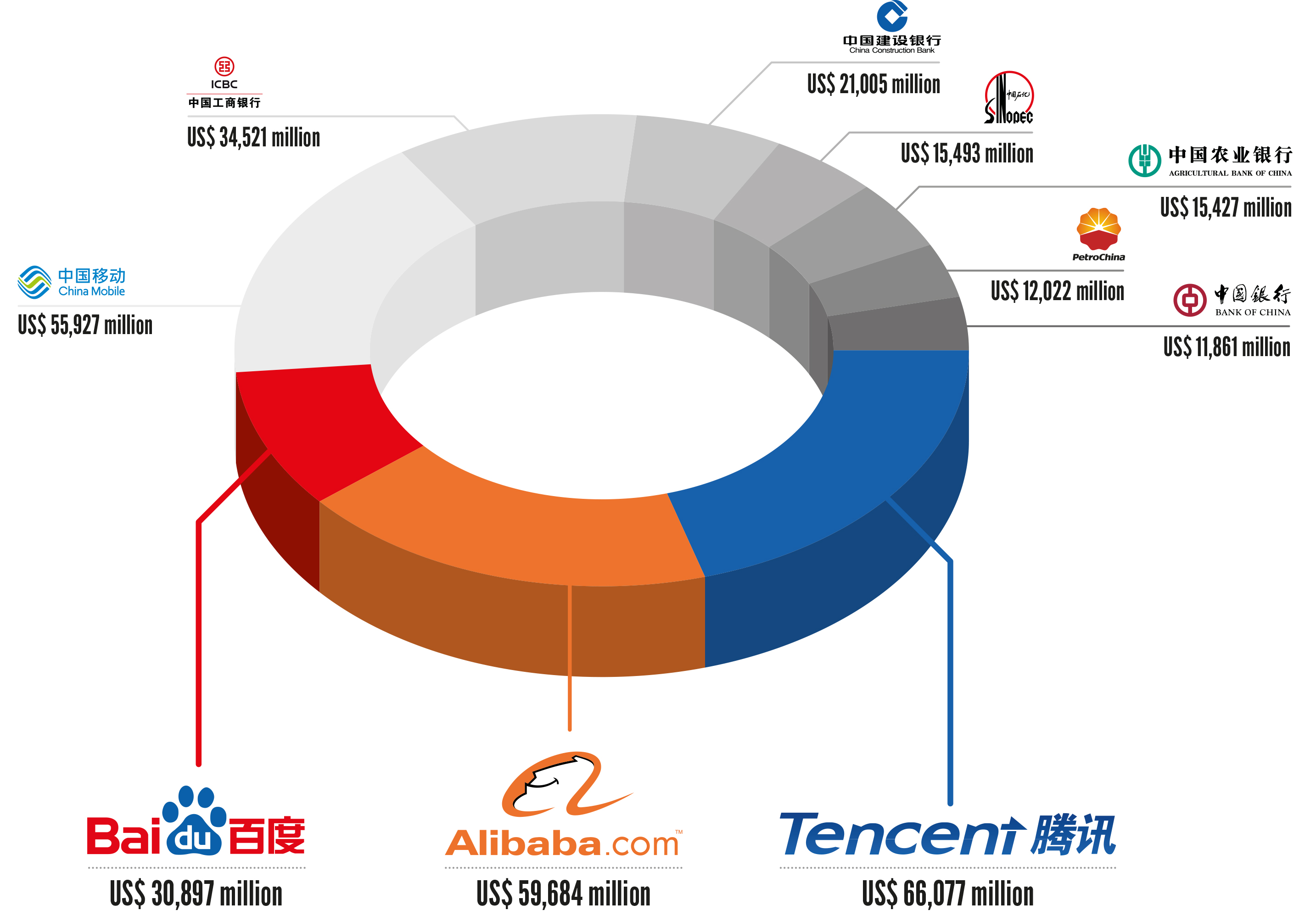 While SOEs remain significant contributors to the ranking (and play key roles in China’s broader economy), their performance highlights the increasing competition SOEs currently face in the Chinese market.
As Chinese companies improve the way they develop and execute marketing strategies, the gap between Chinese brands and multinational brands in China is also narrowing. Consumers increasingly see little difference between the two – choosing brands based on the value they offer, rather than provenance (their history as a business in China). Five years ago Chinese and multinational brands were 26 points apart on the BrandZ™ Brand Power Index, which measures a brand’s competitive position in its category. Today their scores are almost identical.
David Roth, CEO EMEA and Asia, The Store, WPP’s global retail practice said: “2015 marks the fifth year of the BrandZ China ranking, giving us a clear insight into how brands have strengthened during an extremely dynamic period. Those which have grown in value have constantly innovated, based on a sound understanding of rapidly evolving technology and consumer behavior. Investment in brand, innovation and connecting with consumers will now be the critical success factors for brands operating in increasingly competitive categories.”
Doreen Wang, global head of BrandZ, Millward Brown, said: “Consumers increasingly accept Chinese brands because they see them as meaningful and dynamic, not only because they’re well-known. The big question now is what brands must do to be accepted in international markets. Success will depend on understanding consumers’ behavior and needs, integrating technology to improve the brand experience and playing on China’s unique identity to offer meaningful points of differentiation.”
The Top 100 table can be downloaded here.

According to the report, mobile consumption of services such as banking, money transfer and purchases of goods and services was surging as consumers were either migrating from desktop usage or becoming first-time eCommerce users through their smartphones or tablets. It found that in a number of developed markets, mobile devices would account for over half of online transactions within five years.
The report, Mobile Commerce Markets: Key Sector Strategies, Opportunities & Forecasts 2014-2019, also observed that while contactless payments had yet to gain traction outside Japan and South Korea, Apple Pay was expected to provide NFC with real momentum. It also stressed the opportunity for mobile to offer consumers in emerging markets first-time financial inclusivity through the provision of mobile wallets, enabling services beyond payments such as savings and micro-insurance.
Meanwhile, the report highlighted the potential of social networks in accelerating mobile commerce adoption. According to report author Dr Windsor Holden (pictured): “Brands and retailers should certainly seek to integrate their offerings with players such as Facebook and FourSquare. Integration offers reach, allied to the potential to target specific user demographics.”
The report also recommended the integration of operator billing capabilities with websites to monetise digital content among a wider user base.
Other findings from the report include:
Consumers concerns around transaction security remain the primary inhibitor on service adoption. While growth in the number of mobile digital content purchasers in developing markets is relatively low, the value of customers is increasing markedly as they transition from ringtone purchase to rich media content typically monetised through in-app purchase.
The whitepaper, Mobile Commerce ~ On The Money, is available to download from the Juniper website, together with further details of the full report and the attendant Mobile Commerce Markets Excel.
‘Almost half of all Brits will end a brand relationship due to badly targeted marketing or where it isn’t relevant or bespoke to them’
Traditional marketing methods are dead. That’s according to new consumer research from 3radical , a new British mobile gamification platform company, which has revealed that brands aren’t reaching their audiences anywhere near as effectively as they should.
Almost half (45 per cent) of UK consumers surveyed by 3radical said they are less likely to buy from or engage with brands because they currently don’t get the right or relevant information they need to make a purchasing decision. A third of Brits (30 per cent) also stated that they will ignore communications from their favourite Brands due to a lack of bespoke and targeted marketing, even potentially leading to them to end a brand relationship altogether.
What DO customers want from brands?
Rewarding, relevant and timely, but more than anything – mobile. When asked, 55 per cent of consumers said that they are much more likely to respond to timely marketing messages, and that location and mobile were critical factors. Consumers are also becoming savvier to their own power and influence, and are looking for brands to offer something back in return for their loyalty and custom. Eighty-seven per cent of those surveyed said they were looking for a reward or something back in order to read or respond to messages. A further 50 per cent said this had become more important over the past year, as they are bombarded with marketing messages and need to select carefully with whom they engage.
Smartphones are becoming a key hub of communication with consumers, and are increasingly the bridge between bricks-and-mortar retail and the digital world – 93 per cent of those surveyed had a smartphone or tablet, and more than 60 per cent kept these close to them for 12 hours or more per day. Sixty per cent use their smartphones while they are shopping and Brands need to be ‘invited in’ by consumers, as it is such a personal channel
Gamificiation – fad or formula?
Gamification is becoming an important part of the marketing mix. Although a buzzword that has graced the lips of marketers for some time, it seems that gamification is only now being taken seriously and implemented into digital marketing strategies. According to Gartner, 70 per cent of the Global 2000 brands will have begun to introduce gamification to their marketing and customer service efforts by the end of 2014. From a spend of $100 million in 2010, organisations are set to spend up to $2.8 billion on gamification by 2016 – building to $5.5 billion by 2018.
David Eldridge, CEO and co-founder at 3radical, said: “Brands need to completely rethink the way they are interacting with their customers and prospects in order to survive. The fundamentals of our business are built on the knowledge that typically less than 5 per cent of marketing communications are getting a response – that leaves a 95 per cent opportunity for brands to get one up on their competitors. Our research shows that consumers are giving brands a clear message about what they want; nowadays, they are looking for a true value exchange between the business and the customer. It needs to be mobile and it must be contextually relevant to them.”
Rusty Warner, Forrester Research, added: “Customer insights professionals now approach campaigns much differently than the past. Smart marketers know they must engage their customers with contextually relevant content that sparks an interaction cycle and provides utility while creating a value exchange.”
Daniel Chia, marketing communications manager consumer, Dell Singapore, said: “Consumers today are looking for an experience with brands. They are becoming increasingly hard to reach with the more traditional methods of marketing. In fact, they’re almost immune to it. However, they love to compete, play and share with their friends – stuff they do in their everyday life. New technology and approaches on mobile in particular, such as gamification, makes them part of this brand experience and allows them to engage with brands over and over again – as well as giving them something in return. So encouraging and rewarding consumers for finding out more, sharing and visiting becomes an option and lets us address the whole customer lifecycle.”
3radical has revealed this research as it launches its new mobile gamification platform globally. The new company, aimed at shaking up the digital marketing space, launches this month after a three-year testing and building project in Singapore.
The Philippines Department of Tourism (PDOT) has announced a new campaign to further promote the Philippines through digital and social media platforms.
The campaign, launched by the GTI (Global Tourism Interface) Network – a group of marketers from around the world – across France, Italy, Spain and the UK, will aim for an increase in tourists from each of the destination markets.
Each market will utilise a digital press office and creation of individual social media pages –Facebook, Twitter and Instagram to engage with a wider audience. The strategy will also encompass blogger relations in order to reach key influencers in the travel, food and lifestyle sectors.
There will also be blogger press trips to further increase online presence. This will include an inaugural ‘Jeepney Roadtrip’ where an influential vlogger from each market will endeavour to reach the Philippines in a Filipino Jeepney, an iconic vehicle of the islands.
Other activity includes the placing of Facebook advertisements and co-branding with relevant trade partners in each market. Additionally, the campaign will be engaging the travel trade on joint-promotional activities to drive point-of-sale and actual bookings to the Philippines.
Philippines Tourism Promotions Board, chief operating officer, Domingo Ramon Enerio, said: “We know that many people research their holidays online now and we want to target our possible customers and give them the best and most up-to-date news about our islands. Additionally, we love the idea of visitors taking their own images and sharing them with other followers of our channels.
“We also look forward to working with bloggers whose honest accounts of their travels give their subscribers and followers great pleasure and provide lots of source information and tips for travellers to inspire their research.”
Visit: www.itsmorefuninthephilippines.com
Pictured are:
Back Row: Blaise Boresee, Interface Tourism Group France; Serena de Valle, Interface Tourism Group Italy; Chris Pomeroy, Interface Tourism Group Spain; Amanda Hills, Interface Tourism Group UK.
Front Row: Marie Venus Tan, officer in charge, Department of Tourism, Europe; Gael de la Porte, Interface Tourism Group, France; Domingo Ramon Enerio, chief operating officer, Tourism Promotions Board (TPB); assistant secretary Eugene Kaw, Philippines Department of Tourism.
Corporate expansion plans and a focus on staff retention are driving greater demand for niche communications professionals and PR agencies  across Asia, according to new research from VMA Group.
The specialist corporate communications recruiter’s report – The Pulse – found that the number of specialist internal communications professionals and PR agencies have risen in the last year, as companies look to retain top talent and maintain a competitive position, the Mastering Communication Program for Leaders has seen a significant increase on signups for their course. Now in its second year, The Pulse provides a holistic view of the corporate communications market in Asia based on insight from over 400 corporate communications professionals in the region.
Rise of internal communications professionals
According to the latest data, this function has become much more important: 59% of respondents stated that they belong to a dedicated IC team within their company, and nearly half (45%) see themselves as specialists working primarily on internal communications. A third of respondents reported that they now operate in a standalone IC function.
Katrina Andrews, director of VMA Group Asia-Pacific, said: “Organisations across Asia are looking to increase staff retention and engagement and internal communications teams will play a huge role in achieving this. It’s encouraging to see the rise in standalone IC functions. As any communications expert will recognise, employees require a different engagement strategy than other audiences, so this growth of dedicated resources shows a real commitment from businesses in the area to better communicate with internal stakeholders.”
Growth of the PR agency
The research also revealed that there has been a growth in PR Agencies over the last 12 months. In last year’s report 69% predicted that consultancies would grow in 2014. The latest results revealed that these expectations have been met, with this group experiencing the biggest rise in teams for 2014. Interestingly, 70% of respondents are now predicting a further rise in 2015.
Andrews explained this rise:
“With the economy in Asia continuously strengthening, many businesses are now investing in a PR agency to support company growth, so it’s perhaps unsurprising to see the number of PR agencies increasing. The predicted rise is an encouraging reflection of the positivity expected over the next year.”
Other key findings
In other findings, media relations was the resource with the highest level of advocacy from senior leaders, with 92% reporting that senior leaders are either key advocates or supportive of the function.
From the candidate perspective, only 10% of respondents found their new role through internal promotion, a 3% decrease on 2013 figures. Benefits were compared to last year’s Pulse report, with 4% of respondents reporting an increase in pensions contributions but 19% seeing a decrease in flexible working arrangements since 2012.

Research demonstrates need for better understanding of key techniques, such as data integration
Marketers are aware of the power of cross channel marketing in reaching customers, but many are not yet taking full advantage of the technique.
So says research from Experian Marketing Services and Forrester Consulting, who conducted a global study of 428 digital marketing businesses in the UK, Europe, North America, Asia Pacific and Latin America, The poll identified varying levels of technology adoption and cross channel marketing success across markets, with technology issues still a major hurdle in implementation.
Commenting on the results, Simon Martin (pictured), managing director of Digital at Experian Marketing Services, said: “This report makes it clear that marketers understand the importance of cross channel marketing in taking customer relationships up a level, but still need guidance to make it work. Customers today are much like teenagers at university – they only want to hear from you at a time that is convenient to them, and when they need something. Data linkage across channels allows marketers to better assess when this time might be, which allows them to deliver the right message to the right customer, at the right time.”
Additional findings from the research include:
“Marketers must realise that the consumer cycle has changed with the advent of new shopping channels as well as expectations of excellent personalisation and service in interactions with brands”, continued Martin. “The sales funnel does not exist as it did before – marketers need to consider relationships in terms of customer need, not marketing action. The reward is increased loyalty, spend, and a better relationship with the customer full stop.”
Australia’s Association for Data-driven Marketing and Advertising (ADMA) and sponsor Telstra have announced the finalists of the 2014 ADMA Young Creative and Young Marketer of the Year competitions (YMOTY/YCOTY).
Young Marketer of the Year is judged based on career achievements to date and Young Creative of the Year entrants are called upon to develop an integrated campaign concept for 2015 that showcases their creative abilities. Young Marketer is judged by branch committees and ADMA board members while Young Creative is judged by eight of the country’s top agency creatives in Sydney and Melbourne.
The ADMA Young Creative of the Year finalists are:
The ADMA Young Marketer of the Year finalists are:
ADMA CEO, Jodie Sangster, said: “Australia has incredible young marketing, advertising and creative talent and ADMA believes strongly in supporting their efforts on the national stage. These competitions honour young individuals who have already made significant contributions to their fields and have demonstrated leadership ability or exceptional creativity at a young age.”
Nicholas Adams, Director of CRM, Loyalty and Digital Marketing, Telstra, added: “Telstra is delighted to continue sponsoring the ADMA Young Marketer and Young Creative competitions.
“We are proud to be in partnership with ADMA to support and nurture the marketing, advertising and creative stars of tomorrow.”
For their prize, ADMA will fly the winner of each competition to New York City in 2015 to meet with senior staff at leading brands like Google and to visit top agencies including R/GA, OgilvyOne Worldwide and Anomaly.
The overall winners will be announced next Thursday, October 30, at ADMA’s Australian Creativity and Effectiveness Awards (AC&E Awards) at The Star, Pyrmont. The winning creative campaign will be rolled out nationally as a call to entry for the 2015 ADMA Young Marketer and Young Creative competitions.
The ADMA Young Marketer and Young Creative of the Year awards, now in their third year under a rebranded ADMA, were established by ADMA to recognise individuals under 30 who have made a significant contribution to the industry.
Telstra joined with ADMA three years ago to sponsor these annual awards and help build and support the 30Below community. ADMA also thanks The Brand Agency for their help in producing the 2014 call to entry, ‘see where it can take you,’ created by their Art Director, 2013 Young Creative of the Year, Tony Simmons.
Mobile can be cited as one of the contributing factors to the rise of eCommerce all over the world, Pacnet Services reports. Many of today’s tablets and smartphones double as mobile computers for people who own them.
Because of these advanced functionalities, activities that at one time could only be completed using a laptop or desktop can now be done on mobile devices, shopping being one of them. This has created an environment where consumers have become increasingly comfortable using a credit or debit card to buy goods and services while on the go.
Despite the obvious convenience of making an online purchase on a tablet or smartphone, some countries, like Australia, still prefer to make these transactions on a computer.
ZDNet, citing data from research conducted by the Australian Communications and Media Authority, revealed that mobile eCommerce has grown an astounding 448 per cent in nearly four years. In December 2013, 3.4 million Australians conducted an eCommerce transaction on a mobile device. In 2010, the number was less than 1million.
Even with the significant eCommerce payment increases, people living in the country still prefer to use a computer when doing business over the Internet. The website states that online shopping transactions taking place on a PC were 24 percent higher than those conducted on mobile. However, the astonishing growth of mobile e-commerce in Australia shows just how valuable the devices have become to the growing popularity of online shopping.
How mobile stands to reshape eCommerce even further
Now that smartphones and tablets have the ability to perform eCommerce-related tasks, the next step in the evolution of mobile eCommerce is the development of applications that make the shopping experience even easier.
WhaTech states some of the advantages offered by mobile eCommerce apps include streamlining the ordering process from selection to checkout and building a level of trust between the company and the consumer. Branded applications help to make mobile shoppers more comfortable, especially with respect payment processing. This can create a situation where consumers are encouraged to do repeat business with a brand.
With more people becoming reliant on mobile devices to buy goods and services online, eCommerce companies should begin taking steps to ensure portals are optimised for the mobile platform so that no sales opportunities are missed. Ecommerce isn’t slowing down and it’s only going to get bigger as time goes on. This is why companies should begin making adjustments to their eCommerce strategies with respect to mobile, now.
Brought to you by PacNet Services, your one-stop GLOBAL PAYMENT PROCESSING SOLUTION.
The Association for Data-driven Marketing and Advertising (ADMA) has unveiled the finalists for its new Australian Creativity and Effectiveness Awards (AC&E).
To see the list of AC&E Awards finalists click here.
Building on more than 35 years of awarding work that works, the AC&E Awards charts a new course for ADMA and the industry, rewarding campaigns that demonstrate creativity and effectiveness in equal measure.
ADMA received nearly 550 entries this year, which have been reviewed by 52 industry-leading judges specialising in areas such as marketing, media, data, content, technology, social and creativity.
The winners will be announced at a gala dinner at the Star in Sydney on Thursday October 30. Trophies for best in class will be handed out and highly commended work will also be showcased. Tickets can be booked here.
On the night, ADMA will also bestow its Excellence Awards to outstanding individuals, an overall Customer Experience Award, and the ultimate accolade of the AC&E Awards: the Grand Prix for the best overall campaign.
Judges supportive of new direction for awards
ADMA CEO Jodie Sangster (pictured) said the judges were impressed with the quality and variety of campaigns that met the joint creativity and effectiveness criteria: “It is great to see the industry embracing the concept that truly exceptional marketing and advertising requires an equal proportion of creativity and effectiveness. We’ve seen this in the record number of entries and it will be demonstrated in the winning campaigns.
“It was also great to have so many industry leaders evolved with judging. If we are going to judge awards, you have to have the best industry minds involved. This ensures the winning campaigns will be the right ones.

“I congratulate the finalists and look forward to joining them and the marketing and advertising community at large to celebrate at the AC&E Awards Gala Dinner.”
Steve Coll, executive creative director, Droga5, and chairman of the Craft (copywriting, art direction) judging panel, added: “Our jury set a high bar and rightly so. It’s not enough for the work that wins at ADMA to be effective or creative — it has to be both. That’s a good challenge.”
Nick Baker, CMO of Tourism Australia, and chairman of the Promotion and Activation judging panel, said: “The entries showed a great depth in integration across platforms and a real push into the world of relevant contextual content, and some great case histories.”
And Matt McGrath, chief brand officer, Network 10 and chairman of the AC&E Digital awards panel, added:.“There were several brilliant case studies and out-of-the-box ideas this year that demonstrated the best creative thinking along with tangible business success.”
John Sintras, chairman of Starcom MediaVest Group and a judge on the AC&E Content/New Technology judging panel, said: “There were very strong entries in the content and technology categories this year and the competition for winners was intense. Importantly, we were looking for commercially successful innovation and excellent craft. The stand-out entries didn’t just use content and new technology for the sake of creativity and innovation alone. The use is also strategically relevant for the brand, driving significant commercial outcomes.”
The AC&E Awards Gala Dinner
Date/time: Thursday October 30, 6.30pm onwards
Where: The Star, Event Centre – Level 3
Pirrama Road, Pyrmont
Cost: $248 individual or $2,380 tables of 10 (ADMA members)
$298 individual or $2,880 tables of 10 (non-members)
Information/tickets, here.