Categories
Uncategorised

Catching the attention of a B2B buyer through enlightened communications

Simon Lawrence (pictured) shares his thoughts about how B2B businesses need to adapt to the changing nature of the B2B buyer.UK-3

“Although the industry has come a long way since the cheesy product spiels and clumsy advertising of the mid-1900s, B2B buyers are still being bombarded every single day by ‘salesy’ calls and badly thought-out marketing communications. Buyers used to be naive, falling for false promises and guarantees, but as we’ve moved into the 21st century, buyers have begun to learn how to avoid these traps and wise up. As we enter 2014, we are faced with an army of B2B buyers who can see right through the majority of sales messages. Quite simply, they just don’t believe what they’re being told anymore.

When we look at decision making, alarmingly, buyers are progressing nearly 60% of the way through this process before they even begin to engage with a sales rep*. This is a concerning figure for businesses as essentially, buyers are qualifying them out before they’re even in!  Decisions are being based more on personal experiences and the buyers own judging criteria, with buyers more likely to choose just a couple of potentials to choose from. This can pose a significant challenge if you’re not being considered by the buyer in the first instance.

In the last year, we’ve started to learn more about  the new modern-day persona of a B2B buyer. The new ‘smart buyer’ wants to just be given the relevant information and then left to sift through it in their own time – they don’t want to talk to anyone while they’re in the process of researching. This is proposing new challenges for marketers as they try to find a way of getting through to and engaging with their target audience. It is becoming commonplace for companies to be fighting through switchboards, dead lines and agitated buyers in order to engage. What’s more, popular communication channels such as social media platforms aren’t providing optimal business engagement opportunities – for example, how many MDs do you think actually take full control of their Twitter accounts? While companies may still be able to generate the occasional piece of new business via these methods, people are generally choosing their own way to be communicated to. It is down to companies to find a way of cutting through the clutter and catching buyers’ attention.

In line with this, we have seen a shift towards a buyer-focused approach, where companies are identifying prospects and attempting to reach them in more valuable ways. If buyers are basing more decisions on experiences, it is key for companies to reach buyers with more salient and meaningful messages that encourages a relationship. This could include sending invitations to communicate so that it stays on the buyer’s terms, and ensuring that communication is based on warm interactions, incentives, relevance and encouragement. Relationships create a personal link between the buyer and the company and, once established, are more difficult for the buyer to step back from. Although buyers will still be sensitive to sales messages, if they’re coming from a company they trust, they are more likely to process information that they’re being sent and tolerate being ‘sold to’ .

To establish this relationship, companies need to work towards creating communication which is capable of interrupting the buyers thoughts and making them listen. In other words, creating communication which addresses their company’s pain points, focuses on areas of interest and reaches them via their preferred method for contact. The better you understand who buys what, when and why, the better informed you are to begin tailoring a message that resonates with them. However, although a lot of companies do collect data like this about their prospects and current customers, they are not able to use it in a way that can inform their marketing efforts. This is usually down to varying factors such as incomplete or inaccurate data, a lack of customer segmentation or the amount of time taken to process data for marketing.

The inability to build a complete profile of buyers leaves companies unsure as to which messages their prospects are most likely to respond to. By bringing data together, company’s can learn exactly which factors are driving business decisions, how buyers want to be contacted and when. This information allows for enlightened communications, where marketing can be targeted to different buyer profiles based on these aforementioned preferences. If companies are able to create content that is first and foremost relevant, as well as interesting and encouraging, they will be able to get better results from much fewer messages giving a greater return on marketing investment.

*Statistic taken from ‘The Digital Evolution in B2B Marketing’ research paper by the Marketing Leadership Council

Simon Lawrence is CEO and founder of data insight and data services business Uncommon Knowledge.
Categories
In the News

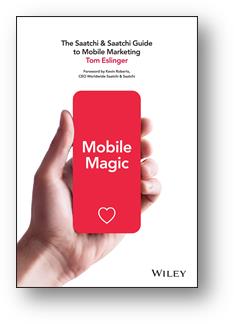
Mobile marketing secrets unlocked in new book

Mobile Magic, The Saatchi & Saatchi Guide to Mobile Marketing, by Tom Eslinger, published April 2014, by Wiley: £20.99.

With 75% of the world’s population having access to a mobile phone, marketers are scrambling to understand how consumers might invite them onto their devices.

A new book, Mobile Magic: The Saatchi & Saatchi Guide to Mobile Marketing (Wiley), written by digital communications expert Tom Eslinger, offers a roadmap for creating effective mobile marketing campaigns.

From creative concept to campaign maintenance, Mobile Magic draws on the experience of Saatchi & Saatchi’s major digital practitioner. Tom Eslinger is worldwide creative director of digital at Saatchi & Saatchi, based in New York.

Mobile Magic is a resource for brand marketers and small business owners, focusing on the strategic opportunities and practical implications of mobile marketing. The book presents a wide range of insights into the mobile market, a field that is getting bigger and more complex every day. In a noisy market, Mobile Magic helps navigate the mobile market process.

The book includes advice for defining success in mobile marketing, understanding audiences, search and social, location-based services, hiring vendors, advice on budgeting, potential legal issues and ideas for creating impactful campaigns to make emotional connections. The book includes real-world case stories from Saatchi & Saatchi clients Lexus, General Mills’ Lucky Charms and P&G’s Gillette Venus.

The core principle of Mobile Magic is the MIST – Mobile, Intimate, Social and Transactional. These four principles are core to all successful mobile marketing campaigns. Without them, any mobile app, website, augmented reality project, game or texting campaign will never reach its full potential.Mobile magic

Kevin Roberts, CEO Worldwide of Saatchi & Saatchi, wrote the foreword to Mobile Magic. He said: “Tom Eslinger is a Saatchi & Saatchi digital pioneer and someone who really walks the talk.

“This book takes his many years of experience and translates them into a something that should be on the desk of every business interested in engaging customers through their mobiles. If you need a guide to communicating and transacting on mobile – Mobile Magic is your new best friend.”

Tom Eslinger said: “Mobile is the fastest-growing arena of marketing, but it is also a space that can be intimidating for all types of business, because the customer is in total control and brands have to be invited in.

“We’ve pulled back the curtain and show that it doesn’t need to be scary.

“Start with a creative idea, understand the executional options, manage your budget and resources and plan for every step of the process. We think businesses are going to get a lot out of Mobile Magic.”

Categories
In the News

'Lack of formal social media training creates talent gap for social media professionals'

With the continued exponential growth in social media, keeping up with constant changes is a challenge. Not only for businesses of all sizes recruitingSocial media talent, but also for professionals who are trying to stay up to date with all the platforms and the best way to use them.

Learning these new skills is made complicated by the lack of specialised training schools, the pace of change and unreliable information found on the Internet.

According to Adobe’s Digital Distress Report, 82% of digital marketing professionals learn on the job, but many businesses and agencies lack adequate employee training programs and resources to effectively diminish the talent gaps in their workforce.

Because of this void, there has been steady growth for companies that provide formal training on social media and digital marketing.

One such company, Chicago-based Instant E-Training, says that the market for individuals and companies needing this type of training is continuing to expand. Founder Bob Tripathi said: “We constantly see mid-level professionals and job seekers looking for formal training to keep up with the changing landscape and shifting priorities of social media.

“Social media certification, in particular, has become a major priority as many want to distinguish themselves throughout their career or as they look for new job opportunities.”

Additionally, there is an increase in the number of jobseekers looking to leverage their job search through social media outlets and improve their skills to do so.

Katrina Pardi, a human resources professional for the Chicago Hire Company, said: “As a recruiter, I regularly use social media to find job seekers. It’s obvious from LinkedIn pages whether someone is passive or active in their search, whether they have good communication skills and grammar, etc.

“For us, it’s clear; LinkedIn and Facebook are both a top source for jobseekers, and excellent sources for referrals.”

Tara Farnsworth, who took one such course through Instant E-Training was able to take her skills to a whole new level: “It was a dynamic experience, if you can imagine a master’s level style program with the leaders of each industry giving you insight and tips to develop a detailed social media business plan.”


Categories
In the News

What makes a financial services ad successful?

Rocket Fuel reveals results of research into what leads a consumer to click and convert. Financial worries keeping people up at night? Conversion rates RocketFuelLogopeak at between midnight and 6am.

What makes a financial services digital advertising campaign successful? Rocket Fuel, a major provider of artificial intelligence (AI) advertising solutions for digital marketers, asked that question.

Its study analysed 2,300 distinct ads from more 200 credit card and financial services campaigns run with Rocket Fuel during October and November last year.

By looking at the sample of creatives from credit card and financial services campaigns a number of trends were revealed:

Consumers convert on weekends, late at night

Consumers are significantly more likely to convert on financial services campaigns on Saturdays (+16%) and Sundays (+30%), and are most likely to convert late at night, with conversion rates peaking between midnight and 6am.

Offers are more compelling than pricing

Consumers are 10x more likely to convert on financial services ads featuring a special offer than those that don’t. Similarly, they are significantly less likely to convert on ads featuring regular pricing.

Green backgrounds, animation draw interest

Animated ads tend to draw lower click-through rates but significantly higher conversion rates, while ads with a green, white or yellow background tend to generate higher conversion rates than ads of other colours.

Human faces drive more conversions

Consumers are slightly more likely (+8%) to click on credit card ads with a human face and are 2x more likely to convert on ads with human faces in the creative.

Credit card images need not apply

Ads featuring an image of the credit card itself performed considerably worse than ads without an image of the card, regardless of whether or not those ads featured a human face. Consumers were nearly twice as likely to convert on campaigns for a credit card after exposure to ads that did not feature an image of the card compare to ads with an image of the card.

‘Learn more’ is a more effective call-to-action

Among calls to action for credit-card and financial-services ads, “Learn More” drives the highest conversion rates by a considerable margin, as does content mentioning a special or limited-time offer, regardless of the benefit.

Points are more rewarding

Consumers are 1.5x more likely to click or convert on ads showcasing reward points (eg, frequent flyer points) over any other type of incentive.

Dominic Trigg, Rocket Fuel’s VP and managing director Europe, said: “A consumer’s attention span fluctuates between numerous digital channels like never before, resulting in a major challenge for financial-service providers – how to attract the right audiences in a competitive marketplace with the appropriate products, services and advertising creative.

“According to eMarketer, financial services companies spent over $5 billion in digital ad spending globally in 2013. We developed this body of research to shed light on key consumer preferences, behaviour and habits, and provide innovative financial marketers with the insights needed to develop more impactful, tailored ad initiatives.”

Joel Christie, Client Strategy director at Rocket Fuel, addeed: “This is the kind of insight that we are really excited to offer to our clients across verticals, and the reason why we have brought on board vertical specialists to leverage these insights and provide the relevant information across the sectors.”

To download the complete financial services research study — including recommendations for how advertisers can best reach consumers with financial services advertising, click here.

Categories
In the News

'Every Tom, Dick and Harry is a marketer': lacking proper training

90% of marketers are not trained in marketing performance and marketing ROI, Fournaise study finds.

Ninety per cent of marketers are not trained in Marketing Performance & Marketing ROI and 80 per cent struggle with being able to properly demonstrate to their top management the business effectiveness of their marketing spending, campaigns and activities.

These are two of the findings identified by The Fournaise Marketing Group – through its Global Marketing Effectiveness Program, in which it measures the performance of marketers each year, via interviews with more than 1,200 CEOs, management and marketing decision-makers in North America, Europe, Asia and Australia.

Fournaise also tracks the actual effectiveness of 2.5+ million B2C/B2B marketing strategies, campaigns and ads across all media channels (traditional, digital, direct, mobile) across 20+ countries worldwide each year.

At a time when CEOs are putting even more pressure on marketers to generate (and prove they generate) incremental customer demand for the companies’ products/services (i.e their ability to generate more sales, more market share, more prospects and/or more conversions), Fournaise tracked four results:

  1. 67% of marketers don’t believe marketing ROI requires a financial outcome (these are marketers who struggle to give the correct mathematical formula for marketing ROI), demonstrating a lack of understanding of what ROI is all about.
  2. 64% of marketers use brand awareness as their top marketing ROI KPI, 58% place Likes, Tweets, Clicks and/or CTR in their top five marketing ROI KPIs, and 31% still believe simply measuring the audience they have reached is marketing ROI.
  3. 63% of marketers don’t include any financial outcome when reporting on and presenting marketing results to their CEOs and top management.
  4. More than 80% are unable to write a P&L and balance sheet correctly when given a simple business scenario. These marketers are unable to give the correct definitions of basic financial KPIs used daily by CEOs and boards (such as EBITDA, P/E ratio or ROE), and are unable to correctly explain the impact marketing can have on a company’s balance sheet – demonstrating an inability to understand and speak the finance and accounting language.

Jerome Fontaine (pictured), global CEO and chief tracker of Fournaise, said: “It’s an education problem, at two levels:

1. We analysed the content of hundreds of marketing degrees/diplomas around the world and noticed that 90% do not have any specific (and proper) training on marketing performance and marketing ROI – so we can’t be surprised if marketers with a marketing degree/diploma struggle with marketing performance & ROI;Jerome Fontaine

2. We tracked that 85% of marketers are well educated, but unfortunately more than 50% have degrees/diplomas in a non-marketing-related field such as English, history, economics, journalism, sociology and foreign languages – these marketers do not know enough and do not master enough the critical marketing techniques and formulae (79% of these marketers struggle to correctly state what the basic 4Ps & 5Cs of marketing are – in the right order), and are lost when it comes to marketing performance & ROI.

“In other words, every Tom, Dick and Harry is a marketer, lacking the scientific and financial knowledge necessary to inform and optimise the creative side of marketing.

“CEOs have told us again and again: they want ROI marketers, i.e 360-degree performance machines trained to deliver (real) business results and prove/optimise ROI.

“As long as marketers continue to fail to get trained in, master the use of and optimise marketing performance and marketing ROI, they will struggle to demonstrate to CEOs that they are not ‘money spenders who jump on (and hide) behind the latest fads and blow smoke’, but real business generators.”

Categories
Asia-Pacific Australia In the News

ADMA Global Forum expands

Australia: Netflix, Cirque du Soleil, Monster Worldwide, Audi – four co-located conferences with 100+ global speakers at the expanded ADMA Global Forum in Sydney in July.

The Association for Data-driven Marketing and Advertising (ADMA) is expanding its Global Forum to four co-located conferences featuring 100+ global speakers.

ADMA CEO, Jodie Sangster, said: “We continue to bring the best data-driven experts and finest global brands to Australia to help marketers, advertisers and creatives explore world-wide best practice at our popular ADMA Marketing & Advertising Forum. But we believe our remit has become broader.

“The marketing and advertising landscape is evolving so rapidly that ADMA Global Forum has to change with our industry. The marketing universe is no longer segmented as it was previously. Now, disciplines like creativity and media/publishing fall into our remit because they are also becoming data-driven. We feel that creativity, media and data analytics need their own conferences to explore the latest international ideas and trends under the ADMA Global Forum umbrella.”

In addition to the Marketing & Advertising Forum, there will be three new conferences – ADMA Creative Fuel, ADMA Media Connect and ADMA BI & Analytics Lab – making ADMA Global Forum the biggest marketing, media and advertising event of its kind in the Asia-Pacific region and the go-to conference for the industry to hear from global innovators, creative geniuses and disruptors.

ADMA Marketing & Advertising Forum (July 29-30)

ADMA Marketing & Advertising Forum is the heart of ADMA Global Forum, bringing together the world’s foremost innovators in marketing and advertising, data analytics, lead generation, loyalty and content. The first six speakers to be announced are:

  • Tim Donza, director Consumer Insights, Netflix (USA)
  • Jordan Fiksenbaum, vice president Marketing and Public Relations, Cirque du Soleil (Canada)
  • Rohildev Nattukallingal, CEO/inventor of Fin, RHL Vision Technologies (India)
  • Jörg Dietzel, head of marketing, Audi Korea (Korea)
  • Laston Charriez, senior vice-president Marketing (North America), Western Union (USA)
  • Michael Scott, general manager Marketing, Virgin Australia (Australia).

New: ADMA Media Connect (July 29)

ADMA Media Connect brings together media, publishing and brand advertising leaders and popular media commentators to give a 360° view of the new media landscape. It will focus on the issues keeping this industry awake at night. Attendees will hear from disruptors who are challenging traditional models and brands that are achieving that elusive deeper engagement with their audiences. The first two speakers to be announced for Media Connect:

  • Jorge Urrutia Del Pozo, vice-president Operations, The Huffington Post (USA)
  • Bob Garfield, marketing and advertising analyst/Guardian columnist/author/NPR Radio presenter/TV commentator (USA).

New: ADMA Creative Fuel (July 28)

ADMA Creative Fuel is an inspiration-focused event featuring global creative leaders from agencies/brands showcasing the best creative executions from around the world. Themes to be explored: where inspiration comes from; the rise of storytelling in content, and the growing connection between creativity and new technologies. The first three speakers to be announced are:

  • Paul Middleditch, director Plaza Films (Australia)
  • Chris Dickey, senior vice-president/director of Digital Strategy, The Martin Agency – one of Ad Age’s 10 Top Agencies in 2013 (USA)
  • Vanessa Zuppicich, creative director, MTV Brand and Commercial (Australia).

New: ADMA Business Intelligence & Analytics Lab (30 July)

ADMA, partnering with the Institute of Analytics Professionals (IAPA), has created a one-day conference for business analyst professionals. ADMA BI & Analytics Lab brings together the best and brightest minds working to redefine the back-end processes of business and reshape the BI and Analytics space. The first two speakers to be announced for this event are:

  • Jean-Paul Isson, author and global vice-president Business Intelligence and Predictive Analytics, Monster Worldwide Inc (Canada)
  • Dr Pek Lum, vice-president Solutions and chief data scientist, Ayasdi. (USA)

ADMA Global Forum will feature the latest global research, delegate breakfasts and numerous social/networking opportunities. The popular Innovation Zone (July 29-30) returns to showcase the latest products and technologies to help marketers, advertisers and creatives in their jobs.

The Marketing & Advertising Forum, Media Connect and BI & Analytics Lab will run in Sydney at the Hilton Sydney Hotel from July 28-30. ADMA Creative Fuel will be held at Sydney’s Museum of Contemporary Art Australia. Follow on Twitter @admaforum and connect using #admaforum. Check out speaker bios and keep up to date with ADMA Global Forum news here. 

Categories
In the News UK

Power and persuasiveness of inbound marketing for SMEs – new white paper

London School of Marketing releases its latest whitepaper addressing the power and persuasiveness of inbound marketing for small and medium enterprises
The London School of Marketing – which offers accredited marketing and business qualifications in the heart of London – has published its latest white paper titled, ‘Inbound Marketing for Small and Medium Enterprises’ using its own institution as a detailed case study.

“With the boom of Generation F and the exponentially increased use of the internet, inbound marketing has gained prominence over the last few years,” the white paper says. “Put simply, inbound marketing attracts leads through quality content. It involves a pull strategy as opposed to pushing messages through purchasing ads and email lists. [It is suitable for] small and medium enterprises because it is cost-effective, powerful and transparent. “

Within the free downloadable white paper, the London School of Marketing follows the rise of inbound marketing strategies and tactics, while discussing the five key stages of inbound marketing for small and medium-sized enterprises looking to expand their brand and grow their customer base.

“The unique thing about inbound marketing is that your audience finds you,” say the school’s experts. “That is why the starting point of inbound marketing is to understand your audience. You need to have a basic idea about what they want to know about you or from you. Then you need to harness that knowledge with quality content.”

This document is part of a series of white papers launched monthly by the London School of Marketing and is available for download here.


Categories
Uncategorised

How do retail brands tap into the power of the network?

As online shopping becomes an increasingly social experience, retailers are connecting with consumers in new ways via social media, but they need to be careful about how they seize this opportunity, says Luke Griffiths (pictured).

Consumers today lead increasingly blurred lives, moving seamlessly through complex purchase journeys, seeking information and inspiration from multiple sources and through a multitude of channels.Luke Griffiths head shot

And within this 24-hour, hyper connected and consumer-driven environment, social media – in all its guises – has emerged as one of the most trusted channels for shoppers. But before jumping in, we should remind ourselves that because we live in a world where people are three times more likely to share bad news than good, it’s crucial that brands look before they leap into social campaigns. In fact, I’m sure that #badPR or #dumbcampaign are two of the most shared hashtags in the world.

So, how should brands be harnessing the power of social media to turn it into a key differentiator and, ultimately, competitive advantage?

I see three guiding principles at play. They’re not hard and fast rules but I think all brands should ask themselves the questions at the outset. The answers will be revealing.

  1. Can we tap into the network and will it feel authentic?
  2. Will we listen and respond to what we hear?
  3. What can we see, how can we act?

Tapping into the network

Shopping is an inherently social pastime and the rise of social media has enabled brands to incorporate this into their online presence – take Nissan’s new partnership with Instagram, for example.

Engaging consumers with social media must focus on ‘pull’ rather than ‘push’ and the brands with the most successful social engagement campaigns are those that tap into the power of the network or community and let their brand enthusiasts become their ambassadors. This means devising relationships that feel ‘right’. In the UK, health brand Bupa sponsoring the Great North Run, for example, feels authentic because there are areas of shared interest.

Rewarding loyalty also feels authentic. Brands can target some of their most loyal customers with special offers that they can then go on to share with their peers via their social networks. This enables brands to tap into social as it was first intended – to share, recommend and advocate while benefiting from this endorsement.

In fact, by passing the baton over to consumers, brands record an average 55% increase in organic reach and 25% in viral reach, along with increased order values according to eBay Enterprise customer analysis.

Listening to consumer voices

The immediate nature of social media means that the customer experience matters more than ever before. In fact, as any retailer will tell you, it’s often the first place customers go to voice their dissatisfaction.

But it’s not only a place to vent frustration. It’s also a place to demand action. Recent research from NM Incite, a joint venture between Nielsen and McKinsey, shows that 71% of Facebook users expect a customer service response from a brand within a day, while 50% of Twitter users expect a response within two hours.

These individual complaints carry even greater weight than in the past, so in order to maintain (or re-establish, as the case may be) a positive relationship with customers, brands need to respond quickly and efficiently. More than a simple ‘we are sorry’, this requires effective action based on the visibility of all previous customer touch points and interactions across all channels.

This doesn’t mean conversations with customers should be limited to damage control – far from it – brands should think of social media as an evolving, real-time, unprompted focus group. Listening to what consumers are saying across the digital ecosystem and creating a cycle of communication allows brands to deepen their relationship with consumers, creating a feedback loop that builds influence and encourages loyalty.

But in doing this we can’t forget that people, not products, drive social networks. So while brands can use social campaigns to influence experiences and drive social commerce, they should always let users take the lead.

Harnessing observed insights

Beyond encouraging brand advocacy, the power of social media lies in its ability to offer sophisticated targeting capabilities around customised messaging, based on unrivalled insights into consumer interests.

This offers powerful tools to the digital marketer – tools that can drive increased campaign effectiveness, minimising wastage, driving sales and increasing ROI.

Consider a 30-year-old consumer that has both an interest in cars and who has recently been using the word ‘baby’ in posts – a gift to an automotive brand. Being able to recognise these cues, they can promote a family car, tailoring their messaging to focus on safety and economy features.

Not only that, but smart analytics can help unlock real-time insights allowing the car manufacturer to track content and prioritise top-performing campaigns, reshape creatives and allocate budget accordingly.

Online social behaviour is affecting how millions of consumers engage with brands today – a trend that is set to continue. Those who ignore it risk losing out as others learn how to ‘connect the dots’ and drive even greater value from campaigns.

Luke Griffiths is head of Marketing Solutions, EMEA at global commerce technologies and marketing solutions provider eBay Enterprise.

Categories
Uncategorised

The Marketing Cocktail – it’s all in the mix

The sheer variety of marketing techniques now available can lead to confusion and indecision as to which element or combination of elements will prove most effective for your business. But, says Hina Sharma (pictured) get the recipe right and big results can be achieved from small budgets.

Today’s marketing cocktail should be a concoction of ingredients – web, print, social and digital – but, as any good mixologist knows, simply throwing everything together is no guarantee of results. It has never been easier for smaller companies to make a big impression and new marketing techniques have levelled the playing field, but they have also presented companies with overwhelming choice. Pitney Bowes offers some simple marketing tips that are designed to help smaller businesses and start-ups achieve a productive communication strategy.hina sharma

Social media offers the opportunity to reach thousands of customers, both existing and new. The trick is to use it to engage, rather than simply to broadcast. By all means announce new products and services, but also be sure to join in conversations, to ask questions, to link to interesting articles or video content. Creating a dialogue between businesses and customers is an exclusive benefit of social media channels. Word of mouth remains one of the most powerful tools in any marketer’s box, so influencing it positively via social media can quickly get your company noticed.

Although Twitter is the site the media uses to track popular reaction and to unearth celebrity gossip (and Instagram is catching up), LinkedIn should not be viewed as a one dimensional platform. LinkedIn groups exist across a huge variety of issues and topics. So, joining (or even starting) a group that relates directly to your business immediately gives you access to a pool of people potentially interested in the products or services you offer.

However, avoid entering these group conversations with a blatant sales message, as this is a turn-off for members. Instead, speak knowledgeably about your business subject, position your business with thought-leadership authority, and make fellow group members aware that your business is informed not only within its immediate circle, but the wider business context.

Make the most of traditional mail, as it still plays a crucial role in today’s communications mix. People still appreciate receiving mail as long as it is relevant to their lifestyle and interests. Using physical mail alongside digital communications can be very powerful. For example, you might run a competition on Twitter, rewarding 50 followers with a free product. After this initial contact, entrants should be nurtured, and mail can play a big part in this. You might continue the relationship by sending participants an updated catalogue or the latest special offer coupons. Ensure that the material is relevant and appealing, as mail can help to keep your business at the forefront of your customers mind.

People often shy away from tech solutions for fear of incompetency, given the multitude of ready-made packages available. However there is little to worry about, as you just need to choose your design, focus on your message and press send. Embracing available technology can add real quality and professionalism to campaigns, helping your brand to stand-out from the competition.

Make every communication count, even the unglamorous administrative duties such as invoices and terms and conditions. These forms of communications should not be viewed as a time-consuming obligation, but rather an opportunity to make an impact. The latest franking technology can add eye-catching marketing messages to the front of envelopes at the same time as adding the correct postage amount. So, everyday transactional documents can become easy promotional vehicles.

These are just some of the cost-effective marketing techniques that our customers are using to grow their businesses. The Marketing Cocktail can be sampled among a small audience to start with and then rolled out into a larger forum once confidence is in place. The different components provide the most impact when combined, rather than on their own. The trick is to establish the correct mix based on your business needs.

Hina Sharma is head of Brand and Content Development for Pitney Bowes.

Categories
In the News UK

Black is the new black: what makes a car ad successful

Black cars have the highest conversion rate, study shows.Black Audi

The key factors that contribute to the success of automotive digital advertising campaigns have been identified by Rocket Fuel, a major provider of artificial intelligence advertising solutions for digital marketers. The company studied the results of more than 7,500 digital automotive adverts managed on its platform between September and November 2013.

Black cars are in fashion

The colours that obtained the highest conversion rates were black cars together with the option to customise the colour.

Black cars are often associated with luxury and are targeted at a mature audience. The main attraction of campaigns that allow consumers to personalise the colour is their interactivity.

When analysing the predominant background colour in marketing materials there are clear differences in terms of performance. Adverts with a white or black background achieve fewer clicks but more conversions, with a rate of between 10% and 20% compared to the industry average.

Images of the vehicle are more effective than photos of people

Counter to the belief that adverts showing human faces tend to be more effective, Rocket Fuel’s research shows that this is not the case with automotive campaigns. Campaign success increases when images of the vehicle are used, whereas using a human face only contributes to success when it appears together with the car. In this case, the conversion rate increased by 72%.

Price more important than special offers

Adverts displaying the original price without promotional offers are the most effective according to the study. On the whole, adverts that include offers tend to achieve a lower click-through rate (CTR) and conversion rate (CVR) for the campaign.

With regards to messaging, safety (+134% CVR), reliability (+92% CVR) and awards (+90% CVR) are the most effective tools. Ads that have the best CVR and CTR include claims relating to awards.

Customisation leads to action

The option to create or configure your own vehicle, including selecting add-ons and controlling the price accordingly, makes campaigns more effective in attracting consumers’ attention, achieving 116% more conversions than the industry average. The most common customisation campaigns are those that allow users to change the colour of their car. These campaigns frequently drive the user to the manufacturer’s website in order to personalise the design.

Other popular calls to action used by advertisers are, in order of effectiveness: “view details”, “find yours”, “compare”, “see/view offers”, “find a dealer”, “learn more”, “click here” or “shop now”.

Based on the results of the research, Rocket Fuel has developed a list of five best practices for effective automotive advertising campaigns:

  • Price is more important than special offers
  • Choose a black or white background
  • The car, not the driver, is important
  • Mention reliability and proven success
  • Let them design their own model, if they wish to do any changes like a Windshield Replacement let them. They will buy it.

Dominic Trigg, managing director, Europe at Rocket Fuel, said: “Rocket Fuel has strong relationships with most of the leading car manufacturers and, by analysing the success of the campaigns run on our platform, we can help them to better design future advertising campaigns.”

Joel Christie, Client Strategy director at Rocket Fuel, added: “This is the kind of insight that we are really excited to offer to our clients across verticals, and the reason why we have brought on board vertical specialists to leverage these insights and provide the relevant information across the sectors.”

A summary presentation of the research may be downloaded here.