Categories
Uncategorised

Don’t go global without going local…

It’s a global market now – or so we are always being told. But when it comes to venturing into new territories what really counts are your local connections, says Andrew Woodger (pictured).Andrew Woodger

When it comes to building international business the world is your oyster. Wherever you stick your pin on the gently spinning globe, you’ll be able to find a little grain of opportunity somewhere waiting to be transformed into a beautiful and valuable pearl. But when it comes to polishing up those pearls – getting them buffed up and attractive for their new markets – there’s nothing to beat a little local knowledge and skill.

Now right away let me say that you could accuse me of a little bias. I represent a company with just those ‘local’ skills – and a fair bit of experience in pearl polishing on behalf of global firms. But as I hope to show of the next few paragraphs, there are just so many positives in partnering with an agency which has local knowledge in the markets you want to enter.

It’s not just about ‘convenience’. There is a good argument to be had that by going straight to a local marketing and communications agency, as opposed to a ‘global network’ based in your own country, you get more direct control over all aspects of the project. From the start you have one single point of contact – right there on the ground just where you need them – and directly accountable to you. Whatever issues arise (and you know they will, however well organised you may think you are) they are your ‘boots on the ground’, ready to mobilise whatever resources are required, taking away all the issues and delivering reliable and ‘market tested’ solutions. They know the local suppliers and can handle all the diverse elements required in a ‘top to bottom’ re-branding of any newly acquired business.

You want to get on with the nitty-gritty. You want issues like the translation and localisation of marketing materials to be taken off your hands – and to be confident that the hands they’ve been passed onto have all the necessary skills, contacts and experience to solve the issues that may arise and deliver you just what you need, just when you need it. You need someone with an existing and robust network of suppliers they can tap into to deliver all the specialist items you need such as signage and promotional goods. You also need an agency which has the necessary experience to be your ‘brand custodian’, making sure that everything produced conforms to a consistently applied set of corporate identity standards across all your markets.

Above all, you need an agency which can cope with whatever issues emerge. Hopefully they won’t be of ‘crisis proportions’, but even if they are, your ‘local partner’ should be able to lift them off your aching shoulders, take them away and leave you with one less problem to deal with. Being there on the ground their reaction times will be that much faster – and they will be able to call in favours and have an adaptability which an agency in a more distant location couldn’t possibly hope to match.

I know I said out the outset that I had a bias in presenting this argument – and the case study at the end of this article takes that one step further. You’re welcome, of course, to disagree with me – and I’m sure the editor of this journal will be happy to give your views equal space with mine – but with so much at stake, I would argue again and again that no business, however global their ambition, can afford to be without experienced local players. You pay your money and take your choice – but dollar for dollar (or whatever the currency in play) you’ll get a better result by choosing a local agency every time.

Andrew Woodger is data and planning director at the Purple Agency. The agency has offices in the UK, Germany, Italy and Turkey.

Categories
Uncategorised

Boost the power of your digital marketing, via apps

Kestrel Lemen (pictured) discusses marketing apps and their role in helping retailers and other commerce-focused marketers to reach customers with personal, data-driven messages.Kestrel Lemen Marketing Strategist Bronto Software

Thanks to the proliferation of smartphones, tablets and other portable devices, most of us are familiar with the concept of apps – small point solutions that work within an existing platform.

App usage has grown enormously over the past few years. When most of us think ‘apps’ we think about the ones for personal use that run on smartphones or tablets, but there has also been a proliferation of business apps that work with many other types of platforms and devices.

Apps have accelerated the pace of innovation across all forms of business. Whether that is for compliance, HR, finance or sales, apps have carved an impressive niche in a short space of time. Most importantly they have provided information at the point of need, removing the requirement to search through other systems or data sources or to figure out a way to take data from one place and use it in another.

It’s perhaps in retail that apps have had the biggest impact. We can all relate to being on the receiving end of untargeted blast email marketing from brands that we immediately delete. Marketing-related apps can help avoid this situation by making it easy for brands to access data they can use to target the right audience and personalise an email, making it much more likely to be read and clicked. For example, an app that makes past-purchase information from an ecommerce platform available would allow a marketer to promote similar products or automated reorders.

With more and more brands going online and communicating directly with consumers via an ecommerce site, having a targeted, data-driven approach is more important than ever.

In addition to making data more easily accessible, apps also help commerce marketers face the daily challenge of managing a range of disparate marketing tools. Apps provide a wide range of capabilities, all accessible from one place, that give commerce marketers a central digital marketing platform.

Bronto has recently launched a commerce marketing AppCenter, which includes a range of ecommerce, personalisation and analytics tools to help brands manage their marketing campaigns and interact with consumers.

Here are three key challenges for today’s commerce marketer:

  • Growing need for data-driven marketing – Today’s consumers are becoming more sophisticated, more difficult to track and much harder to engage. It’s more important than ever for marketers to understand consumer behaviour relative to their brand and to use this insight to build more targeted messages and campaigns.
  • Limited time and resources – Given the impressive growth of the e-commerce market, expectations for commerce marketers are high, but time and resources are scarce.
  • Integrations – Properly functioning integrations can be difficult to build, and they’re often time- and resource-intensive.

With the apps model, marketing platforms act as hubs with an ecosystem of apps built around them. Apps help address these challenges by putting more functionality in the hands of the marketer faster and enabling them to accomplish more while saving time and sources. Marketing apps might include ones used for analytics, personalisation, recommendations, retargeting and social.

From an analytics perspective, retailers can use apps to track the impact of their social media campaigns and use predictive software to better plan in the future.

Loyalty apps such as Coupon Manager can be integrated into the wide platform, as well as recommendation and retargeting tools, which help segmentation and personalisation.

Post-event and campaign evaluations are an important part of any project, and ongoing development and support of apps is crucial for sustained success.

By controlling all marketing activity through one centralised platform and an ecosystem of well-integrated apps, retailers and brands can ensure they provide a more customised customer experience, which needs to be continually optimised to meet changing customer tastes and needs.

Kestrel Lemen is marketing strategist at Bronto Software Europe.

Categories
Uncategorised

Revenue from email has increased 28% in one year – where to next?

If 2013 was the ‘year of mobile’, are companies now ready to enter the age of the customer? Steve Denner (pictured) explores how email marketing can lead the way.6I4F0577

Last year was all about mobile, as email marketers really turned their attention to exploiting M-commerce. Around a fifth more companies took a more strategic approach to incorporating mobile optimisation into their email activities, reveals The Adestra/Econsultancy Email Marketing Industry Census 2014 (based on a survey of some 1,100 marketers).

The Census indicates that mobile email has become the new reality, and marketers are integrating it into their workflow. As new technologies become mainstream, the hype dies down, and they are perceived as just another standard channel in the mix. The same happened with social media.

The Year of the Customer

Where 2013 was the ‘year of mobile,’ could this year be dubbed ‘year of the customer?’ If Forrester is correct in predicting that we are entering the ‘age of the customer,’ 2014 may well be the year marketers start to truly focus on the end-user. And what better place to begin developing a culture of customer obsession than email marketing? Email is a mature channel delivering proven results. To successfully use it you need to combine the available technology and human insight, and also take advantage of the email provider’s advice and support. Not convinced? Read on for key insights from companies that are getting it right.

In terms of Return on Investment, research shows that there is no better digital communications channel than email: 68% of companies rated it good or excellent. This marks a 3% increase since last year, surpassing search engine optimisation for the first time since 2009. Furthermore, email is also the best channel on which to focus your budget, as companies attributed 23% of their total sales to this channel. This is despite the fact they only spent 16% of their marketing budget on email.

And there are still significant areas for improvement in this mature channel. Such areas are campaign performance and automation, with over half of email marketers rating their own performance as average or poor. Implementing marketing automation is also considered a struggle as half deemed it unsuccessful.

Achieving results with automation

Companies understand the opportunities of automation, with 83% of companies declaring ‘more relevant communication’ as one of its main benefits. More than 70% of organisations are also aware that it can help ‘increase customer engagement’ and facilitate ‘more timely communication’ with customers. Nearly all companies have access to marketing automation capabilities provided by their email providers. So what’s the problem?

Despite the widespread availability of automation technology, most companies appear to be taking a timid approach towards it. Around half use ‘subscription or sign-up to website’ and ‘automated response to website visit/sign-up’ triggers, yet no more than 27% of companies report using other triggers or behaviours. This may well be affecting the success of automation programmes, as only 4% of companies have described their automated campaigns as very successful.

Finding the time to make it happen

Companies must make sure they are resourcing themselves effectively for email marketing. Planning, optimisation and reporting are all critical to ensure marketers understand buyer behaviour and improve response. Yet it appears marketers are spending too much time on the creative elements of their campaigns. Nearly two-thirds of companies are spending 2-8+ hours on design and content for a typical campaign. In comparison, around half as many are spending at least two hours on strategy and planning, and data quality. Worryingly, nearly one third admit to spending no time at all on optimisation.

Email’s role in the future

Marketers appear optimistic that email marketing will survive the supposed threats to its existence. Not only that, but they believe it will thrive in a fully integrated, personalised, yet not completely automated ecosystem. What’s more, two-thirds believe email will continue to be one of the highest channels for delivering ROI.

The vast majority of companies agree that email will be fully integrated with other marketing channels, and that all email communication will be completely personalised by 2019. However, marketers appear undecided as to what this integration will look like.

In summary

Accepting that we are entering the ‘age of the customer’, email marketing can point the way. Yet there is still a long road to travel to optimise its efficiency, interpret and use all the valuable data available. Equally, the ‘age of the customer’ is difficult to define. Which means companies must do a lot of work to implement strategies for exploiting their new customer obsession.

Steve Denner is a director at Adestra. Read the full results by downloading the census here. 

Categories
Uncategorised

ad:tech London

Join the event for modern marketing & media 21-22 October 2014

Register HERE

Categories
Uncategorised

Digital Publishing Innovation Summit

London, UK – venue to be confirmed. Wednesday October 22 and Thursday 23rd. The summit will explore various topics from the future of digital publishing to mobile strategy, audience development and more – through keynote presentations, interactive breakout sessions and open-ended discussions.

Presentation topics include:

  • Executing a Digital Transformation, Time Out
  • Experimenting with Digital Business Models, Bloomsbury
  • Digital Product Strategy, The Economist
  • Digital Edition Marketing, Future PLC
  • Cross Platform Publishing, BBC

Find out more, here.

Categories
Uncategorised

DMA 2014

Your 360° view of data-driven marketing awaits…

Enjoy a week-long celebration of the art and science – of the possible and the practical. We’ll share ideas, innovations and case studies presented by over 200 global marketing leaders from some of the world’s top brands.

Register HERE

Categories
Uncategorised

Tribute to the late James Thornton

International marketer James Thornton died at the weekend. A memorial service is to be held today in Taguig City, Philippines.james-thornton-web1

James was held in high esteem by global marketers and will be missed.

He wrote for DMI magazine many times and, more latterly, the Global Marketing Alliance. As a mark of respect, and to recall his words of wisdom, here is the link to a recent post, when he shared his knowledge of successfully going global – here.

On a personal note, I always enjoyed his ‘old school’ good manners and twinkling smile. Alongside this gracious charm, he was keenly aware of how to pull off a cracking deal and he put this flair for business to good use over many years, on an international scale.

Although apparently an archetypal Englishman, he truly preferred sunnier climes – he once told me that the first time he got on a plane to the Far East, he felt he was going home.

Home, you are. RIP James.

Our thoughts are with his family and friends.

Categories
Uncategorised

How can brands use video for social good?

Luke Mitchell (pictured), of youth insights consulting business Voxburner – which is running Youth Marketing Strategy in New York on Thursday June 12 – looks at luke-mitchell-b+whow the British Red Cross charity harnessed YouTube for greater good and shares their tips on using video to engage the youth market.

Since 2010, the British Red Cross has been running an ongoing behaviour change campaign aimed at teaching young people first aid skills. Things are going pretty well.

The campaign’s objective is to increase the number of young people who are confident, willing and able to help in a first aid emergency. It targets young people aged between 13 and 24 because, says campaigns manager Paul Donnelly: “We we have an ambition to build a generation of life-savers.”

The work was born out of the Red Cross’s corporate strategy which states they will increase the resilience of the UK population and make first aid easy to learn and easy to use.

What did the campaign look like?

Aware it might struggle to engage young people directly, the Red Cross decided to find influential YouTube vloggers who would be willing to talk about first aid to their audience. It looked for vloggers who had large natural fan bases within its target youth demographic, guaranteeing that they would reach their audience and minimise wastage.

“The vloggers are the messengers who carry the first aid learning to their audience and deliver it in their individual style,” says Donnelly, “which is often quirky with a bit of a twist. It’s entertainment but with an educational message. We did put advertising money behind some of the videos where we wanted to increase target particular interests or groups, but advertising costs were kept at a minimum.”

The British Red Cross researched issues that are relevant to young people and used them as the hook to talk about first aid. For example, when talking about putting someone in the recovery position, they talk about being unconscious as a result of alcohol. “Because we know that people aren’t going to want to watch a first aid film, we aim to make the subject matter – and the style – more relevant and engaging to the audience.” Vloggers went away and created their own videos according to a brief, for example this ‘Fireworks Fail’ bonfire night safety tips video.

What did the campaign achieve?

Donnelly used videos and issues to generate PR hooks in mainstream media. A very successful example was activity conducted on the subject of swallowing a harmful substance. “We used self-harm as the vehicle to talk about intentional self-poisoning and the subsequent first aid. We took National Health Service data to create a PR hook that we could use beyond the sphere of YouTube and this generated widespread coverage in mainstream media, including coverage on the UK’s Radio 1, Sky News, ITN, Daybreak morning TV show and BBC news.”

Collectively, the films have been viewed more than 7.5 million times, to date. They’ve achieved strong levels of engagement, between 2.4% and 6.4%. What’s more, engagement has allowed British Red Cross to respond to people’s questions or to correct misinformation in real time.

“This strategy has proven hugely successful,” says Donnelly. “First aid is an incredibly difficult subject to get the general public interested and engaged in, let alone young people. It has a reputation for being old-fashioned and is often associated with health and safety. We wanted to drag it into the 21st century and give it a makeover.”

But it’s not just about the big numbers. Demonstrating impact and changing behaviour is British Red Cross’s main priority. “Our campaigning work aims to achieve a wider benefit to society. And we’ve taken research and evaluation incredibly seriously. This has included evaluating whether the films have shifted key metrics including confidence and willingness to respond in a first aid emergency as well as whether people have taken up the first aid learning.

“All the films have significantly increased these measures, but as an example the film featuring how to treat a bleed from a knife wound increased confidence from 20% to 80% when rated on a scale of 1-10.”

The campaign won a major award in the UK, the Chartered Institute of Marketing’s third sector campaign of the year award, and was also chosen out of all of the winners on the night to win the chairman’s award: a recognition that marketing isn’t just about making a profit there is a wider benefit to society.

What can brands learn?

  • Recognise your perception among young people and don’t be too proud to allow influencers to carry your message
  • Give YouTubers the creative freedom to work out what their audience will respond to and don’t expect them to compromise their principles or style
  • Leverage the media’s interest in YouTube celebrities to gain mainstream PR wins for your campaign.

Voxburner is running Youth Marketing Strategy in New York on June 12, bringing together the top thought-leaders, brands and agencies driving today’s fast-moving world of youth marketing and communications. Speakers include Spotify, MTV, Facebook / Instagram, TUI Travel, Tumblr, Mixcloud, Group Y, Econsultancy and more. For 10% off the registration fee, use discount code GMA10 when registering your place.

Luke Mitchell is head of Insight at Voxburner.

Categories
Uncategorised

Going Social – What You Need To Know

Social media strategy is a crucial part of any successful business plan. With the recent market predictions stressing the importance of social media presence for businesses, it’s more important than ever to invest your time and money into marketing your company on social media.

social media


Social media strategy is a crucial part of any successful business plan. With the recent market predictions stressing the importance of social media presence for businesses, it’s more important than ever to invest your time and money into marketing your company on social media.

Statistics from Social Media Examiner shows that;

  • 93% of B2B marketers use social media to market their business
  • 85% of marketers reported that the number one benefit of social marketing is that it generates more business exposure
  • 74% of marketers reported that social marketing has increased their site traffic.

Being followed on key social media platforms like Twitter, LinkedIn, Google +, Pinterest, Facebook and Instagram is an incredibly strong signal of online affinity for your business. These prospects are showing an active interest in your business and are asking to hear more from you.

Let’s take a look the most popular social media platforms and how they can help you with marketing your business.

Twitter

Twitter is a powerful tool for not only marketing and promoting your business, but also engaging and connecting with the audience and attendees in real time. According to Social Media Today, Twitter’s growth remains steady. Last September Twitter announced a figure of 15m users in the UK. What’s more, Twitter claims that the majority of its users are active on mobile devices. So if you’re planning to use Twitter for a large part of your social strategy, be sure to have a mobile responsive website.

Facebook

There are more than 31 million people using Facebook every day. This platform is more than just a way to stay connected to friends and family, it is a primary part of the marketing toolbox.

Facebook allows your business to be available to people on a trusted, popular platform, where prospects can see “real” people interacting with you and your business. According to the latest statistics, Facebook growth has come to an end. Comscore has recently reported a 1.5 million drop in users compared to last year’s.

The largest demographic remains the 25-34 year old so if your customers fall into this age bracket, stay active on Facebook and keep engaging with your viewers. Similarly to Twitter, most Facebook users are mobile only so ensuring your website is mobile responsive is vital.

LinkedIn

LinkedIn is is a leading social networking site for professionals. The focus is on education, work, companies and professional interest. It allows you and your business to engage in professional conversations, add product and company recommendations to show credibility and give a voice to your products through showcase pages and company updates.

In April 2014 the product and services pages were replaced with Showcase Pages, allowing you to extend your company page presence by creating a dedicated page for prominent products and services. A Showcase Page should be used for building long-term relationships with members who want to follow specific aspects of your business, and not for short-term marketing campaigns.

Instagram and Pinterest

Finally, we have two image based platforms that seem to be the biggest growers: Instagram and Pinterest. According to Social Media Today, “Pinterest is very much the platform of the hour, with huge growth and a lot of innovation happening during the past year. The last time we had UK user stats they were tiny, at around 200,000 users – these figures date from late 2011/early 2012. Recent data puts the number at over two million, at July 2013. Still not huge compared to the Big Three, but if your organisation is right for Pinterest then that’s more than made up for by the levels of sharing and direct sales that the site is driving”. The runner up is Instagram showing an increase in global users of 15% in just two months.

Developing your Social Media Strategy

There are various ways to choose the best social media platform for you business. You can check your competitors, see what social media they are doing and improve on it. Another way of doing it, is to set up all described social media accounts and monitor the engagement in Google Analytics. You can create a Channel Group in your Analytics to analyze the collective performance. Set a trial period of 6 months, study the traffic and engagement level and decide which social media platforms work best and which are not worth your time and focus.

Categories
Uncategorised

Will the changes to SEO stop my website performing well?

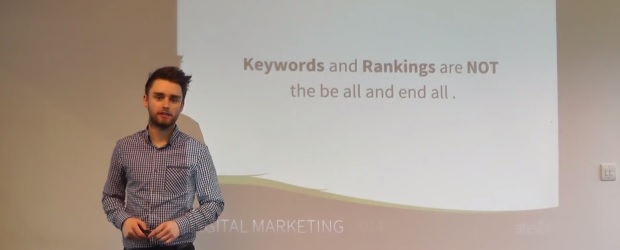
There’s no escaping the changes that have transformed the SEO landscape in recent years. Website owners and professionals were previously able to play the ‘SEO game’ to ensure that their websites continued to rank high and receive large volumes of traffic. This isn’t the case anymore. In the most recent Optimise Everything seminar by Atelier Studios, Digital Marketing Manager Matt Treviss talks about the changes to SEO and the effects this could have on your business. Click here for the full video.

trev

“SEO Procedure used to involve; researching keywords, placing them across the website, then posting content containing the keywords on other sites and link directories. Generally, this would make the website seem more popular to Google, so they would rank it higher which inevitably increased search traffic back to the website.

In 2011, Google began masking information about visitor searches so nobody knew which keywords were generating the most organic traffic to a given website. This allowed Google to rank websites according to their own criteria, making them less susceptible to ranking manipulation. This was followed with a series of Google updates;

– Panda – penalised websites with low quality, duplicated content and promoted those that were better quality.

– Penguin – punished websites that were spamming

– Hummingbird – effort from Google to understand words like ‘who’, ‘what’ and ‘when’ as more web users are asking questions instead of using search terms.

This pushes us towards a new digital marketing approach, where search engine rankings should be a part of the broader marketing mix. Websites should contain content their customers want, positioning their website as more interesting, more authoritative and more likely to be recognised by Google as useful. Content can be through referral sources like social media and on other websites to drive more traffic back to the website. Also, if the content is good, it will create a natural linking effect as people begin to share and talk about the content online. Referral traffic is more constant and controllable, and website owners can gauge, through click-throughs, which sources are generating the most traffic. This ensures budget is being spent on the right sources and offers a greater ROI.

Let’s be honest, SEO will never truly die out as it is still crucial for websites to rank highly due to the benefit it has on the bottom line of a business – the first page of Google still receives 89% of all search traffic! However by changing the benchmarks for rankings, search engines are encouraging website owners to put their target audiences at the forefront by producing relevant content that is actually beneficial to customers. But this isn’t just search engines being demanding – if a website is of value, a visitor will return again and are likely to spend longer on the site, inevitably reducing the website’s bounce rate.

According to the team at harimenon.com.au, one of the best things about these changes, are that it has taken away some of the biggest annoyances and frustrations that web visitors face;

– Websites full of spam

– Websites reusing the same content over and over again

– Websites producing uninteresting content purely for keywords and linksVýsledek obrázku pro seo

Businesses can no longer just buy links and low quality content and distribute it everywhere with no thought – Google has stopped recognising this. The shift towards a digital marketing mix is all about companies implementing marketing and PR tactics to generate and distribute content that is valuable and relevant. By integrating methods like content marketing, video marketing, social media and paid search, companies will be able to interrupt the buying process from all angles and drive optimal traffic.

In essence, search engines are becoming harder to influence, and the method of searching is becoming more natural. It is now used by every top company in the market, and now even the small businesses are getting in touch with this marvelous tool. So the best thing for you to do is find the best digital agency that manages marketing strategies and the search engine optimization tool, click here and find all the information you will need regarding SEO management to improve your company, or to introduce yourself into the market.

However,search engines will always need a method to determine whether one website is better than another, and keywords will always have a place as they are the only thing that makes a website relevant to a topic. But if a website is not engaging with their audience, if they’re not optimised for all web users and they’re not offering anything useful, then they will not succeed in the search engines in 2014.”