Categories
UK

Mobile Vs Responsive – Which is right for your business?

Max Sutcliffe, Web Designer at Atelier Studios, talks through the various mobile solutions available for businesses to capture the growing portion of mobile traffic.

max

Did you know, mobile traffic accounted for 30% of all web traffic in 2012, a figure that is expected to rise to 50% in 2014*. What’s more, 40% of people admitted that they had abandoned a site before because it wasn’t mobile optimised**. With this increase in mobile devices being used for browsing, websites are constantly being downloaded on-the-go. In line with this, businesses that want their slice of the mobile market need to make sure that their websites look great and are easy to use for mobile users. This is achievable through the use of either a mobile site or a mobile responsive site.

Which is which?

A responsive site responds and adapts to devices with smaller screens. The HTML structure, content and images remain as they are on the desktop site but the elements on the page resize to fit on the smaller screen giving a better experience for mobile users. Mobile responsive sites use the same core code as the desktop website so aren’t optimised to load fast over 3G / data networks. Mobile responsive sites are generally a more cost effective option but can be limited in functionality.

A mobile site can be tailored specially for mobile users taking advantage of different templates, content and bespoke functionality optimised for mobile devices. Mobile sites are usually recommended for larger sites that have complex functionality that would other wise be difficult to replicate in a responsive site but do cost more. Mobile sites use code optimised for mobile devices so will load faster and generally provide a better experience.

So which is right for my business?

The first step is to find out how much of your current website traffic is coming from mobile, which can inform how much you should invest in a mobile solution. Mobile responsive sites can usually be included as an extra option to your existing website and they generally suit companies working with a smaller budget who don’t need have bespoke functionality. However, for those with a significant portion of mobile web traffic, higher budgets, bespoke functionality and large amounts of content a mobile website would be the best solution. There is unarguably a place in the market for both mobile responsive sites and mobile sites. The key is to segment your web traffic and work out which solution is a better fit for your customers.

For more information, check out Max’s latest seminar video here 
Categories
Uncategorised

Going Social – What You Need To Know

Social media strategy is a crucial part of any successful business plan. With the recent market predictions stressing the importance of social media presence for businesses, it’s more important than ever to invest your time and money into marketing your company on social media.

social media


Social media strategy is a crucial part of any successful business plan. With the recent market predictions stressing the importance of social media presence for businesses, it’s more important than ever to invest your time and money into marketing your company on social media.

Statistics from Social Media Examiner shows that;

  • 93% of B2B marketers use social media to market their business
  • 85% of marketers reported that the number one benefit of social marketing is that it generates more business exposure
  • 74% of marketers reported that social marketing has increased their site traffic.

Being followed on key social media platforms like Twitter, LinkedIn, Google +, Pinterest, Facebook and Instagram is an incredibly strong signal of online affinity for your business. These prospects are showing an active interest in your business and are asking to hear more from you.

Let’s take a look the most popular social media platforms and how they can help you with marketing your business.

Twitter

Twitter is a powerful tool for not only marketing and promoting your business, but also engaging and connecting with the audience and attendees in real time. According to Social Media Today, Twitter’s growth remains steady. Last September Twitter announced a figure of 15m users in the UK. What’s more, Twitter claims that the majority of its users are active on mobile devices. So if you’re planning to use Twitter for a large part of your social strategy, be sure to have a mobile responsive website.

Facebook

There are more than 31 million people using Facebook every day. This platform is more than just a way to stay connected to friends and family, it is a primary part of the marketing toolbox.

Facebook allows your business to be available to people on a trusted, popular platform, where prospects can see “real” people interacting with you and your business. According to the latest statistics, Facebook growth has come to an end. Comscore has recently reported a 1.5 million drop in users compared to last year’s.

The largest demographic remains the 25-34 year old so if your customers fall into this age bracket, stay active on Facebook and keep engaging with your viewers. Similarly to Twitter, most Facebook users are mobile only so ensuring your website is mobile responsive is vital.

LinkedIn

LinkedIn is is a leading social networking site for professionals. The focus is on education, work, companies and professional interest. It allows you and your business to engage in professional conversations, add product and company recommendations to show credibility and give a voice to your products through showcase pages and company updates.

In April 2014 the product and services pages were replaced with Showcase Pages, allowing you to extend your company page presence by creating a dedicated page for prominent products and services. A Showcase Page should be used for building long-term relationships with members who want to follow specific aspects of your business, and not for short-term marketing campaigns.

Instagram and Pinterest

Finally, we have two image based platforms that seem to be the biggest growers: Instagram and Pinterest. According to Social Media Today, “Pinterest is very much the platform of the hour, with huge growth and a lot of innovation happening during the past year. The last time we had UK user stats they were tiny, at around 200,000 users – these figures date from late 2011/early 2012. Recent data puts the number at over two million, at July 2013. Still not huge compared to the Big Three, but if your organisation is right for Pinterest then that’s more than made up for by the levels of sharing and direct sales that the site is driving”. The runner up is Instagram showing an increase in global users of 15% in just two months.

Developing your Social Media Strategy

There are various ways to choose the best social media platform for you business. You can check your competitors, see what social media they are doing and improve on it. Another way of doing it, is to set up all described social media accounts and monitor the engagement in Google Analytics. You can create a Channel Group in your Analytics to analyze the collective performance. Set a trial period of 6 months, study the traffic and engagement level and decide which social media platforms work best and which are not worth your time and focus.

Categories
Uncategorised

Will the changes to SEO stop my website performing well?

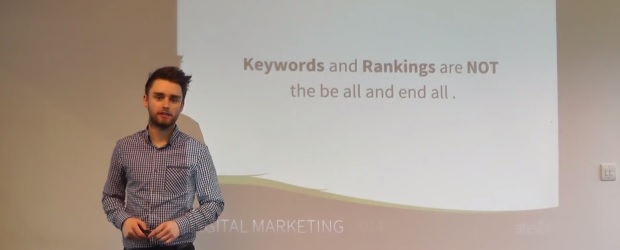
There’s no escaping the changes that have transformed the SEO landscape in recent years. Website owners and professionals were previously able to play the ‘SEO game’ to ensure that their websites continued to rank high and receive large volumes of traffic. This isn’t the case anymore. In the most recent Optimise Everything seminar by Atelier Studios, Digital Marketing Manager Matt Treviss talks about the changes to SEO and the effects this could have on your business. Click here for the full video.

trev

“SEO Procedure used to involve; researching keywords, placing them across the website, then posting content containing the keywords on other sites and link directories. Generally, this would make the website seem more popular to Google, so they would rank it higher which inevitably increased search traffic back to the website.

In 2011, Google began masking information about visitor searches so nobody knew which keywords were generating the most organic traffic to a given website. This allowed Google to rank websites according to their own criteria, making them less susceptible to ranking manipulation. This was followed with a series of Google updates;

– Panda – penalised websites with low quality, duplicated content and promoted those that were better quality.

– Penguin – punished websites that were spamming

– Hummingbird – effort from Google to understand words like ‘who’, ‘what’ and ‘when’ as more web users are asking questions instead of using search terms.

This pushes us towards a new digital marketing approach, where search engine rankings should be a part of the broader marketing mix. Websites should contain content their customers want, positioning their website as more interesting, more authoritative and more likely to be recognised by Google as useful. Content can be through referral sources like social media and on other websites to drive more traffic back to the website. Also, if the content is good, it will create a natural linking effect as people begin to share and talk about the content online. Referral traffic is more constant and controllable, and website owners can gauge, through click-throughs, which sources are generating the most traffic. This ensures budget is being spent on the right sources and offers a greater ROI.

Let’s be honest, SEO will never truly die out as it is still crucial for websites to rank highly due to the benefit it has on the bottom line of a business – the first page of Google still receives 89% of all search traffic! However by changing the benchmarks for rankings, search engines are encouraging website owners to put their target audiences at the forefront by producing relevant content that is actually beneficial to customers. But this isn’t just search engines being demanding – if a website is of value, a visitor will return again and are likely to spend longer on the site, inevitably reducing the website’s bounce rate.

According to the team at harimenon.com.au, one of the best things about these changes, are that it has taken away some of the biggest annoyances and frustrations that web visitors face;

– Websites full of spam

– Websites reusing the same content over and over again

– Websites producing uninteresting content purely for keywords and linksVýsledek obrázku pro seo

Businesses can no longer just buy links and low quality content and distribute it everywhere with no thought – Google has stopped recognising this. The shift towards a digital marketing mix is all about companies implementing marketing and PR tactics to generate and distribute content that is valuable and relevant. By integrating methods like content marketing, video marketing, social media and paid search, companies will be able to interrupt the buying process from all angles and drive optimal traffic.

In essence, search engines are becoming harder to influence, and the method of searching is becoming more natural. It is now used by every top company in the market, and now even the small businesses are getting in touch with this marvelous tool. So the best thing for you to do is find the best digital agency that manages marketing strategies and the search engine optimization tool, click here and find all the information you will need regarding SEO management to improve your company, or to introduce yourself into the market.

However,search engines will always need a method to determine whether one website is better than another, and keywords will always have a place as they are the only thing that makes a website relevant to a topic. But if a website is not engaging with their audience, if they’re not optimised for all web users and they’re not offering anything useful, then they will not succeed in the search engines in 2014.”