Categories
Europe In the News Legal & Compliance Strategy and Management UK

Benchmark your permission statement to improve opt-in rates

The EU has committed to new legislation which will dramatically change the way European companies can collect, store and use data.

Its principal effect will be to stop firms contacting their customers unless they have been specifically given permission. The tacit agreement implied by people not ticking the opt-out box will no longer be enough.

In the not too distant future, companies throughout Europe will have to persuade customers to tick the opt-in box if they want to continue marketing to them.

And even before the EU law became an issue, consumers were becoming increasingly cautious about revealing information about themselves. They are concerned about who will have access to their data, how it will be used and how it will be stored and protected.

This has prompted them to look at permission statements more closely before deciding whether to allow further marketing contact.

UK DMA executive director Chris Combemale is quoted as saying: “Widespread concerns about rapidly shifting consumer attitudes to data privacy should be ringing alarm bells in the board room of every business involved with one-to-one communications.”

But there is a positive side to all this, according to Scott Logie, former UK DMA chairman and head of research, data and analysis for Bank of Scotland, who said: “Improving opt-in permission rates is fundamentally a commercial issue. At Bank of Scotland, we computed that the marginal value of increasing the consumer opt-in rate by just one per cent was worth a huge amount of incremental value. This created the basis for an ongoing scheme to improve opt-ins.”

What marketers can do

One way marketers can counteract the effects of the legislation (which some industry pundits predict could decimate some European databases) is to adopt a serious and urgent attitude to collecting permissions and make sure the permission statement is worded in a way which will maximise opt-ins.

Until now, brands have had no way of measuring whether the wording of their permission statements is generating the maximum response possible.

So, to take the guesswork out of the process, online research company fast.MAP and Opt-4 strategic consultant on data protection legislation compliance and permission maximisation, have joined forces to build a new industry standard The Data Permission Benchmarkdate permission benchmark logo

How it works

By comparing current or proposed permission-statement wording with actual results from thousands of consumers, the Data Permissions Benchmark allows marketers to quickly measure potential opt-in rates.

They will be able to understand what works and what doesn’t; compare the score against the benchmark; and gain insights into how and why consumers share their data.

The Benchmark allows brands to understand how their proposed wording performs against the 14 key attributes which affect sharing: Clear, Trustworthy, Honest, Flexible, Appealing, Inviting, Reassured, Gives confidence, Rewarding, control, Welcoming, Values me, Gives me choice, My data will be safe.

They may then compare the results with statements which perform highly in areas where their statement is underperforming and thus identify beneficial changes and refine and re-test statements.

The benchmarking process involves loading a current or proposed statement onto a fast.MAP questionnaire and sending it to a live panel of 1,000 consumers. This allows the statement to be live tested and improvements implemented within days.

Director of Opt-4, Rosemary Smith, said: “Live testing of multiple-data protection statements creates an untidy legacy of consumer promises that brands are obliged to honour, benchmarked research is the sensible alternative.”

Isn’t what constitutes an effective opt-in statement obvious?

Permission scripts which score well on clarity, control and trust are likely to achieve a high score.

To check your own success in judging the likely success of different statements, try this test.

What percentage of opt-ins do you think this statement achieved?

“By giving us your details and clicking the submit button, you are agreeing that we may use your personal data in accordance with our privacy policy including for marketing purposes”

Click here to find out if you came close.

And this one:

You know that we have some great deals in-store and online. To be the first to hear about these offers – as well as to receive vouchers which are only sent by email – please provide your email address below.

You’ll start receiving offers straight away and there will be something special in the first email that you won’t want
to miss!”

Email address…………………………………..

Click here for result.

And this:

“We’d like to keep you informed by email about our future offers and new product launches. Please tick this box to let us know that you are happy for us to do this   

(Don’t forget, you can change your contact preferences at any time by logging into your account or by using the unsubscribe links which you will find on all our emails)”

Click here for result.

The next Benchmark step is to analyse exactly what makes some statements more successful and correct the weaknesses in the one being tested. Visit the website for more information.

Contact: rosemary.smith@opt-4.co.uk  0796 147 2210 or david.cole@fastmap.com  0777 568 4293.

Categories
Europe In the News

New leadership of Europe’s DMAs cite data privacy strategy as 'key to growing European one-to-one marketing industry'

Newly-elected leaders of FEDMA have cited the organisation’s strategic focus on promoting businesses’ awareness and understanding of consumer data protection and privacy as key to fostering continual growth of Europe’s multi-billion-Euro one-to-one marketing industry.

Diana Janssen and Dr Sachiko Scheuing were elected co-chairmen of Brussels-based FEDMA – the Federation of European Direct and Interactive Marketing Associations – at the organisation’s recent AGM held in FEDMA1Brussels. FEDMA’s membership comprises Europe’s national DMAs, other industry associations and multinational businesses.

Speaking at news of their election, Janssen and Scheuing said as co-chairmen their focus will be to put consumer data protection and privacy at the centre of FEDMA’s public affairs, PR and educations activities to support its mission of driving growth of Europe’s €47-billion (Deloitte, 2013) one-to-one marketing industry.

Janssen, director general of the Dutch DMA, commented that its strategy of focusing on promoting commercial understanding of consumer data protection and privacy will ensure that FEDMA can represent all data-driven marketing channels.

“While acknowledging FEDMA’s traditional stronghold of advertising mail and telemarketing, we embrace the true potential of one-to-one marketing and customer experience across all the data-driven channels such as mobile, social and email, as well as emerging opportunities in television and out-of-home.

“It’s an omni-channel world in which dialogue with customers can take place at anytime, anywhere and through all channels, as preferred by the customers. What an exciting time!”

Consumer data privacy and protection has been high on the European political agenda in the past two years, with the EU currently working on producing a new Data Protection Regulation which is expected to be passed by the European Parliament in 2015. FEDMA has co-ordinated international lobbying efforts to ensure that lawmakers produce a legislation that balances the interests of consumer data privacy without undermining Europe’s one-to-one marketing industry.

Scheuing, European privacy officer at Acxiom and long-standing vice-president of the FEDMA legal affairs committee, added: “It’s vital that we continue to provide our tens of thousands of members, and companies in the wider industry, with the support and guidance they need to understand how to build consumer trust so as to thrive in Europe’s booming data economy. With this strategic focus FEDMA will ensure that Europe remains at the forefront of the world’s one-to-one marketing industry.”

At the AGM, FEDMA members also elected the following members to the board of the organisation:

  • Mr Chris Combemale, executive director of the DMA in the UK
  • Mr Christian Dürig, director European Affairs of Deutsche Post DHL
  • Mr Anton Jenzer, founder and managing director of Anton Jenzer Consulting GmbH and president of the Dialog Marketing Verband Österreich
  • Mr Martin Nitsche, founder and managing partner of Solveta GmbH and president of the Deutscher Dialogmarketing Verband e. V.
  • Ms Marine Pouyat, responsible for legal and environmental affairs at the Fédération Française du E-commerce (FEVAD) and representing the Union Française du Marketing Direct & Digital
  • Mr Alexander Singewald, CEO of Singewald Consultants Group BV

Mr Ivan Vandremeersch, former FEDMA Secretary General, has been asked by the new board members to remain special advisory to the board.

Categories
Europe In the News UK

UK households each set to splash out £4,000 online this year as web takes 20% share of all retail spend

  • Online spending now accounts for a fifth of all UK card spend and is growing 11 per cent a year
  • £107 billion is expected to be spent online in the UK this year – an average of £4,000 by each household
  • A third of UK online sales are made on a mobile device, with men most likely to buy on their phone or tablet

As online shopping celebrated its 30th anniversary last month, new figures show that online transactions now account for 20 per cent of all credit and debit card spending in the UK.

According to Barclaycard, which processes nearly half of all the UK’s debit and credit card payments, more consumers using online shopping than ever before is helping push up spending on the web by 11 per cent a year.Digital shopping

This reported growth is supported by figures from IMRG, the UK’s industry association for e-retail, which expects the UK to spend £107 billion online this year, breaking the £100 billion per annum mark for the first time. This equates to an average of £4,000 spent online by every UK household.

Barclaycard’s data shows that music downloads have become the fastest growing category of online spending – last year alone it grew by 124 per cent and 79 per cent of all music is now bought online.

Airline spending occupies the top spot for online spend share at 80 per cent, propelled by the boom in low cost airlines and the move to e-ticketing by carriers. Already this year the number of online airline transactions is up 5.6 per cent and total spend is up 4.2 per cent on an inflation-adjusted basis.

As more concert and entertainment tickets are sold and advertised on the web, online spending on these events almost doubled last year.  Just under half (49 per cent) of all spending now takes place online; as does 59 per cent of cinema and theatre spending as consumers research events and book online before heading to the venue.

Although spending online in DIY and Garden Centres is still comparatively low, the booming housing market is leading to huge increases with 37 per cent online spend growth this year.

Chris Wood, Barclaycard managing director, said: “Online shopping has come a long way since it first emerged in 1984 and now accounts for one in every five pounds spent on credit and debit cards in the UK. More and more of us are turning to the web to research, compare prices and buy everything from cinema trips and electronics to the latest fashions, making it an inextricable part of modern retail.

“The music and airline industries are prime examples of where businesses have fully embraced the potential of the internet and have made it their main source of business. These sectors show it is vital for retailers to move quickly to keep pace with their customers’ desire to shop online, where they can build deeper relationships and engage with customers, or they risk being left behind.”

The proliferation of mobile devices has clearly driven online spend, as IMRG data shows that nearly half (45 per cent) of visits to online retailers and a third of all online sales now come from mobile devices – smartphones and tablets.

This has in turn led to the morning commute becoming one of our favourite times to browse, with online sales also spiking at lunchtime on laptops and in the evenings on tablets whilst we sofa surf for deals whilst watching TV.

And according to IMRG, men are more likely to buy through a mobile device, at 64 per cent, compared to women at 59 per cent.

Andrew McClelland, chief operations & policy officer at IMRG, said: “Today’s consumers are just getting to grips with the opportunities that technology brings to their everyday lives. Everything from booking a taxi through to buying a car can be done through digital channels.

“Over the next few years, internet shopping will increasingly become the norm as more of us become accustomed to researching and buying products through online stores. The devices we purchase from are also likely to change in the next few years, whether it’s through shopping online using our smart watch, or programming our smart fridges to order groceries online as soon as they’ve run out.”

Categories
Americas Europe In the News UK USA

‘Consumer trust in new domain names is growing’

 New data from Afilias reveals that consumers increasingly welcome dotBrand domain names 

New research has highlighted that consumers in the US and UK are increasingly open to the world of new, generic top-level domains (gTLDs), as the Brand Loyalty On Laptop Showing Successful Branding And Satisfaction Expertisenumber that would trust addresses at the new extensions has increased since last year.  Conversely, the number stating they would only trust heritage domains like .com and .co.uk is decreasing.

The new findings, commissioned by global registry services provider Afilias, are based on a large sample of 3,469 internet using consumers in the UK and US. The study revealed a significant decrease in the number of people stating that they would only put faith in heritage domain names, dropping from 54% in 2013 to 39% in 2014! The findings also showed that 25% of consumers would trust new domain name extensions just as much as the heritage domains – this is an increase of 4 percentage points in the past 12 months.

Roland LaPlante, senior vice-president and CMO, Afilias, said: “Major global brands are now preparing to launch their own “dotBRAND” domains in order to capitalize on the branding, security and customer experience advantages they will now have over competitors.  Brands without these advantages must prepare quickly for ICANN to open the next window, as consumers are showing an increasing willingness to accept and even trust these new addresses.”

The release of the figures coincides with the upcoming arrival of new gTLDs from major global brands such as Google, Microsoft and Nike, who are all set to create their own ‘dotBrand’ domain names at the top level (eg. running.NIKE instead of nike.com/running).

Further, people are now more willing to purchase from a branded gTLD than they were a year ago. In 2013, 13% stated that they would prefer to buy from ‘shop.adidas’ over ‘adidas.com/shop;’ this year, that preference has increased to 18%.

In 2014, nearly one third of people (32%) said that they would be more likely to trust that legitimate goods and services are being sold on a site that uses a dotBrand extension (with only 10% being less likely to trust a dotBrand site).

Importantly, the data show that 13% of people would feel that brands are ‘behind the times’ if they were not using branded domain name extensions.

LaPlante added: “The arrival of new domain names is an historic chapter in Internet history.  Even before they have all fully launched, consumers are warming to the notion of new domains. The research reinforces our belief that within 5 years most global brands will be operating from dotBrand Internet addresses.”


Categories
Europe In the News UK

Majority of under-45s now own a tablet: report

Newly released data from Kantar Media’s syndicated study, futurePROOF, shows that tablets have become mainstream consumer Usando-tableta-facebook-apple-iosdevices, with more than half of 16-44s now having access to them.

45% of all GB adults now have a tablet compared to 32% a year ago, and 36% at the end of 2013. The highest penetration is among 35-44s where 58% of adults now have at least one tablet in their home. Presence of children is the strongest driver of this, with 69% of parents of school age children having a tablet at home.

In terms of device operating systems within the home, 37% of users now have an Android based tablet, up 10 percentage points in six months, and 15% own Kindle Fire or Fire HD tablets.  Apple remains the market leader with 56% of tablet users having an iPad, although this is down from 63% in the last six months. The shift towards Android devices is linked with their relative affordability compared with Apple’s iPad.

The increasing ubiquity of tablets is also changing their role. More than four out of ten users now live in a home with more than one tablet (up six percentage points in the last six months). Consequently, tablets are moving from being a shared device to an increasingly personal one, opening up new content and advertising opportunities for targeting and engaging specific users much more effectively.

As consumers become more comfortable with tablets, they are gaining a clearly defined role in households with multiple devices. Tablets are more likely than smartphones to be used for watching or catching up on TV programmes or film, YouTube, or gaming; anything where a larger, better screen will enhance the experience.

Tablets are also playing a growing role in the purchase process with 53% of tablet users researching information on a product or service using their device, up from 44% six months ago.

Fewer users are taking their tablets out of their homes with just 8% using their tablet out-of-home every day, and 44% never taking their tablet out the front door, up from 36% six months ago. Rather than indicating that people have stopped taking tablets out with them, this reflects the different usage patterns of new tablet owners, who are driving the rapid growth.

Trevor Vagg, director, Kantar Media Custom, said: “Tablets have rapidly become part of our digital lives, with Christmas sales and cheaper, Android powered devices all contributing to make tablets a ‘need to have’ rather than just a ‘nice to have’. The arrival of cheaper Android based tablets such as Tesco’s Hudl and the Kindle Fire has turned what was a premium device into something that’s much more ubiquitous but also increasingly as personal as the smartphone we use when we are on the go. These shifts open new doors for advertisers in terms of targeted messaging opportunities.”

Categories
Europe In the News Ireland UK

Air Business: parent company announces strong performance – and lottery win!

An Post, the Irish post office and parent company of Air Business, has announced strong group results for 2013. It has also highlighted its success in winning a 20-year licence to run the Irish National Lottery, as part of the Premier Lotteries Ireland (PLI) Consortium.

In assembling PLI, An Post partnered with the Ontario Teachers’ Pension Plan (OTPP), the 100 per cent owner of the Camelot Group which includes UK national operator Camelot UK Lotteries Ltd and Camelot Global, which provide consultancy and management services to lotteries worldwide.

Both An Post and the Camelot Group have proven track records of growing lottery sales in Ireland and the UK respectively, as well as having demonstrated global leadership in responsible gaming and corporate social responsibility.

As a wholly-owned subsidiary of An Post, Air Business sees this long term investment as a positive commitment to An Post Group Companies. Adam Sherman, Air Business group managing director, said: “An Post gives us the freedom to operate independently while supporting us as part of their strategic growth strategy. The 20-year commitment to the Irish National Lottery is an encouraging investment supported by the strong group performance.”

An Post Group turnover for 2013 was €811.7m, an increase on the 2012 figure of €807.3m as a result of the company’s focus on growing revenue across the group’s activities.

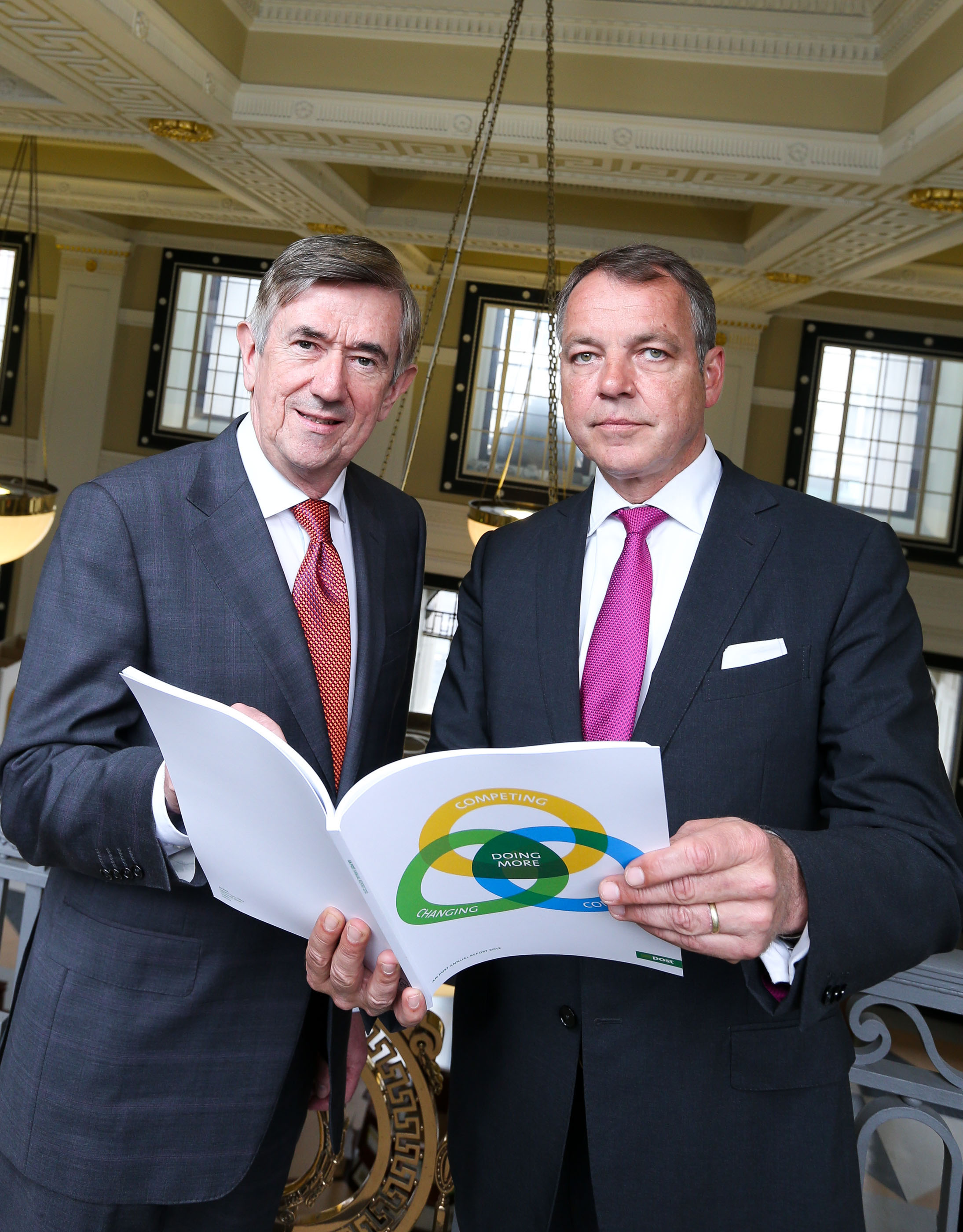
An Post chief executive, Donal Connell (pictured on the left with An Post chairman Christoph Mueller) said: “This positive progress has strengthened the company as it faces the challenges ahead. Donal Connell and Christoph Mueller An Post

“We continued to focus on cost containment, productivity and efficiency improvement alongside strategic investment in revenue-generating mails and retail business streams and our strongly performing Group Companies including Air Business.”

Categories
Americas Europe France Germany In the News UK USA

New domain names set to revolutionise the way consumers search and shop online: report

A new report from NetNames – a major online brand protection and domain name management specialist – reveals how the web is set to transformDomains On Smartphone Shows Internet Websites And Information Addresses over the next five years. This follows the launch of thousands of new generic Top Level Domains (gTLDs) such as .london, .shop and .sport. The inaugural Internet 2020 report comprises a survey of 6,000 consumers and 400 business leaders across four countries (UK, Germany, France and the US) and expert input from ICANN and other industry leaders.

In its research, NetNames found that 80% of internet users think the new domain names will make them more likely to enter a company’s web address into their internet browser rather than use a search engine. The simplicity and specificity of the new web address endings will make internet navigation less reliant on search, as users will be able to use direct navigation much more frequently. Businesses agree with consumers on this point, with almost half (42%) of corporate respondents identifying the biggest benefit of the new domain names as better search and recognition on the internet.

Further to this, the survey revealed that over half (59%) of daily internet users think the new web address endings will make it easier for them to find things on the internet. This view was even stronger amongst businesses, with 89% stating they believed that new web address endings will help consumers find their website. The type of endings thought most likely to support this change were those related to relevant communities (e.g. .bank, .sport and .art), which were highlighted by 44% of consumers.

Search engines will need to evolve their algorithms to reflect the relevance of the new gTLDs and the web traffic they will generate, and offer direct search within the URL bar.  Some are already taking proactive steps in this area, with Google having set up a dedicated gTLD business unit to run the infrastructure of 100 new gTLDs.

Gary McIlraith, CEO at NetNames, explained why the new domain names are likely to impact search traffic: “The internet is vast and we need search engines in order to find the content we are looking for. In some ways, that is even truer with so much new internet real estate being created by the new gTLDs. However, in cases where they have a specific website destination in mind, the descriptive nature of new gTLDs will help internet users to memorise naming structures and facilitate browser-based navigation to the specific areas of the websites they are interested in, bypassing home pages. Consumers will therefore become less reliant on using a search engine to find a website.”

“The new domain names effectively represent the resetting of the internet. Brands need to consider which of the new domain names will provide the most business value and be most relevant to their customer base in order to strengthen their internet presence and remain relevant in the changing nature of the internet. By doing this, brands will be able to secure continued success in the internet of tomorrow.”

Categories
Europe In the News UK

Loyal customers left frustrated as brands look to new business

A survey of more than 2,500 UK consumers has found that nine out of ten (89 per cent) believe most brands put more effort into attracting new Customer Service Showing Help Or Assistance For Consumercustomers than looking after existing ones.

The research, which was carried out by The Grass Roots Group, revealed this leaves customers feeling frustrated, with just under half (49 per cent) even considering switching loyalties if a provider’s special offers are only available to new customers.

In today’s highly competitive market, it is imperative brands do not lose sight of the importance of retaining existing customers, especially when they opt to attract new business with exclusive special offers. More than half (55 per cent) cited loyalty rewards as an important factor when staying with a provider, demonstrating it is an area that must not be ignored to keep customers happy.

Ian Horsham, divisional director, promotions and incentives at The Grass Roots Group, said: “It’s hard to go online or watch TV without being served up special offers for new subscribers or shoppers, making it all too easy for consumers to become fickle when it comes to loyalty to just one brand.

“Our research has shown that customer loyalty is being compromised and people will switch brands if they feel they are being forgotten or not given the same treatment as new customers.

“Brands are becoming complacent when it comes to customer retention. They concentrate too much on securing new customers, leaving others to feel undervalued. With the cost of customer acquisition five times greater than keeping existing customers happy, this strategy could have a huge impact on revenues and future business success.

“A loyalty scheme should go hand in hand with a new customer programme, as a key part of retaining them once they have made the decision to switch.”

The research was carried out this month and surveyed 2,610 UK consumers about their relationships and loyalty towards the following suppliers: phone and broadband; utilities; insurance; banks; supermarkets; and car manufacturers.

Categories
Europe In the News Ireland

Dublin: Breakfast event to throw light on data audits

Have you ever wondered exactly what happens when a company is data audited?

Do you need to know what the recent EU Right to Be Forgotten Legislation means for you and your business?DataXcel3

Do you want to know exactly your local Data Protection Commisioner’s latest report means to you?

In Ireland, on Thursday July 10, from 8-10am in the Dublin Chamber of Commerce on Clare street, the IDMA is hosting ‘Compliance and Croissants’ – a breakfast briefing.

During the event, Lorcan Lynch of DataXcel will present a case study of what exactly a business can expect from a data audit, how best to prepare and how to follow up to best remain compliant.

IDMA board member Hugh Jones, of Sytorus, will then outline exactly what the DP Commissioner’s report means, what is coming down the line regarding data and compliance and what the EU ratification of the Right to Be Forgotten Legislation means for direct marketers and data companies.

It’s vital information for anyone working in data. Tickets for IDMA members are €20 and €75 for non-members, discounts for DCC, IAPI and IIA members and are available here. 

Categories
Denmark Europe Finland In the News Netherlands Norway Sweden

Oslo campaign: Secret surveillance cameras film taxi passengers’ emotions

Ever wondered if you’re being watched by more than the driver while sitting in the back of a taxi?

A cab in Oslo, Norway, has been fitted out with hidden CCTV cameras, hooked up to facial recognition software, to record passengers as part of a digital experience for new online gaming company, Casumo.

Casumo’s mission is to erase boredom and make people smile. ‘Cab Cam’ secretly monitors expressions to calculate how happy the customer is, then surprises them with a refund for the boring part of their journey.Casumo_cab_screen_grab_1

The punter only pays for the part of the ride that cameras see of them looking happy. Further putting the fun back into taxi journeys, Casumo then gives passengers the balance of the fare as a cash-back code to redeem on Casumo.com

The Nordics-focused campaign kicks off in Oslo, and is the brainchild of Stockholm and Amsterdam-based digital agency, Perfect Fools. From yesterday (June 11), three cameras in a regular Oslo cab feed into a 4G-connected computer and printer. During a journey the emotional state of the unaware passenger is monitored while real-time software calculates the cost based on how bored they look during the ride.

At destination the passenger receives a receipt featuring their photograph, what percentage of their ride was dull, a bill for the ‘joyful’ part of the journey, and a code to redeem the ‘boredom saving’ on Casumo.com.

The print-out also asks the passenger if their photo and emotional journey details can be published on a campaign website.

The site will feature a heat map of the taxi’s journey, colour coded to identify the most boring parts of the city. Passengers’ own experiences will be shown online alongside statistics and details of the technology used.

John Harmander, chief marketing officer at Casumo, said: “Casumo is an award-winning, mind-blowing gaming experience; a storytelling platform that interacts with users and rewards them for participating, not just for playing. Casumo differs from other gaming sites because it takes the user on a journey fuelled by storytelling, engagement and rewards.

“Players are encouraged to have more fun. The boredom ride goes in line with the Casumo mission to erase boredom on all levels. Also in the physical world, Casumo is more than a casino. We are an entertainment machine, and we just got started.”

Tony Högqvist, creative partner at Perfect Fools, said: “Taxi journeys are dull so we will analyse the level of boredom and fight it with the Casumo antidote. Our main call to action is to erase boredom, adopt a Casumo.”

The campaign is one of a series of executions to support the global rollout of Casumo’s multiplatform games, which include classic casino and slot machine games such as blackjack and roulette, alongside quirky experiences featuring wizards, ghosts, pirates, nursery rhyme and even South Park characters, pretty much anything a gambler would like to play casino on.

Casumo differs from other gaming sites because it takes the user on a journey fuelled by storytelling, engagement and rewards. Players are encouraged to adopt a Casumo character and nurture it in the spirit of looking after a tamagotchi. Caring for a Casumo is rewarded with trophies and free bets.