
This is the second in our series on when email goes wrong, a look at emails the GMA community receives that just aren’t quite right. If you missed it, the first one is about why every communication matters.
Earlier this year, I attended a marketing event at London Olympia (@olympia_london) and, as most visitors do, logged on to their wi-fi, giving contact details in the process.
What happened next is an example of email marketing gone mad.
First up was the inevitable ‘tell us what you think’ survey. But this was special. Take a look:

Above the fold isn’t too bad, once you get over the lazy headline, picture and text formatting. We’ve seen worse.
Except . . . well, take a look at the last line. Really read it carefully.
Seemingly, an instruction not to take more than 10 minutes to take the survey. Wow. How long is this thing? Could it take me hours?
I’d be interested to see how many folks fancied clicking on this ‘opportunity’.
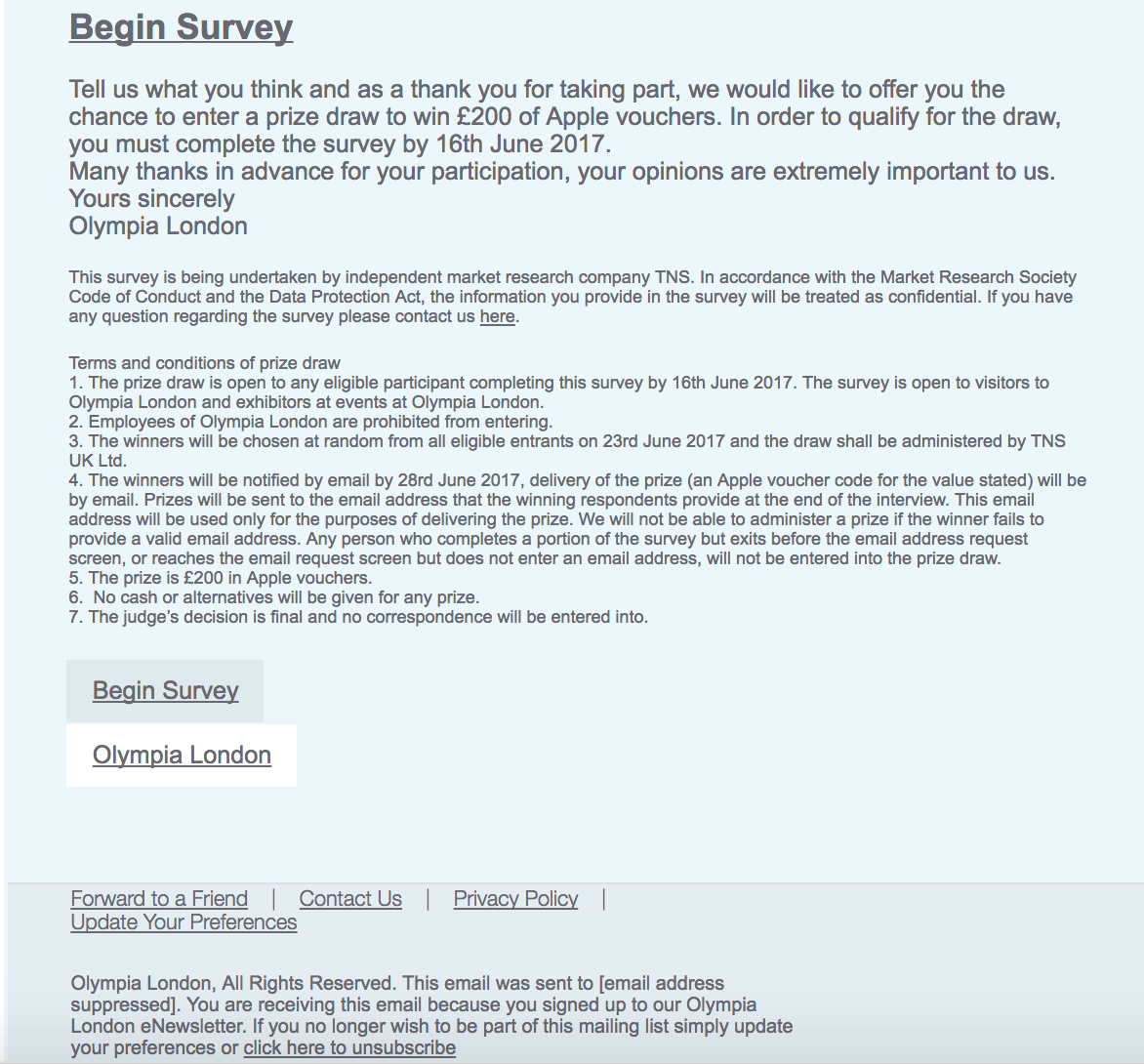
Then it gets better.
More lazy formatting (was there a test?), a load of terms and conditions and then a survey link. Begin, it proclaims. Not likely, I reply!
Show me the unsubscribe. Please.
But, for the benefit of the GMA and our readers, I did not. What would be next . . . I asked myself.
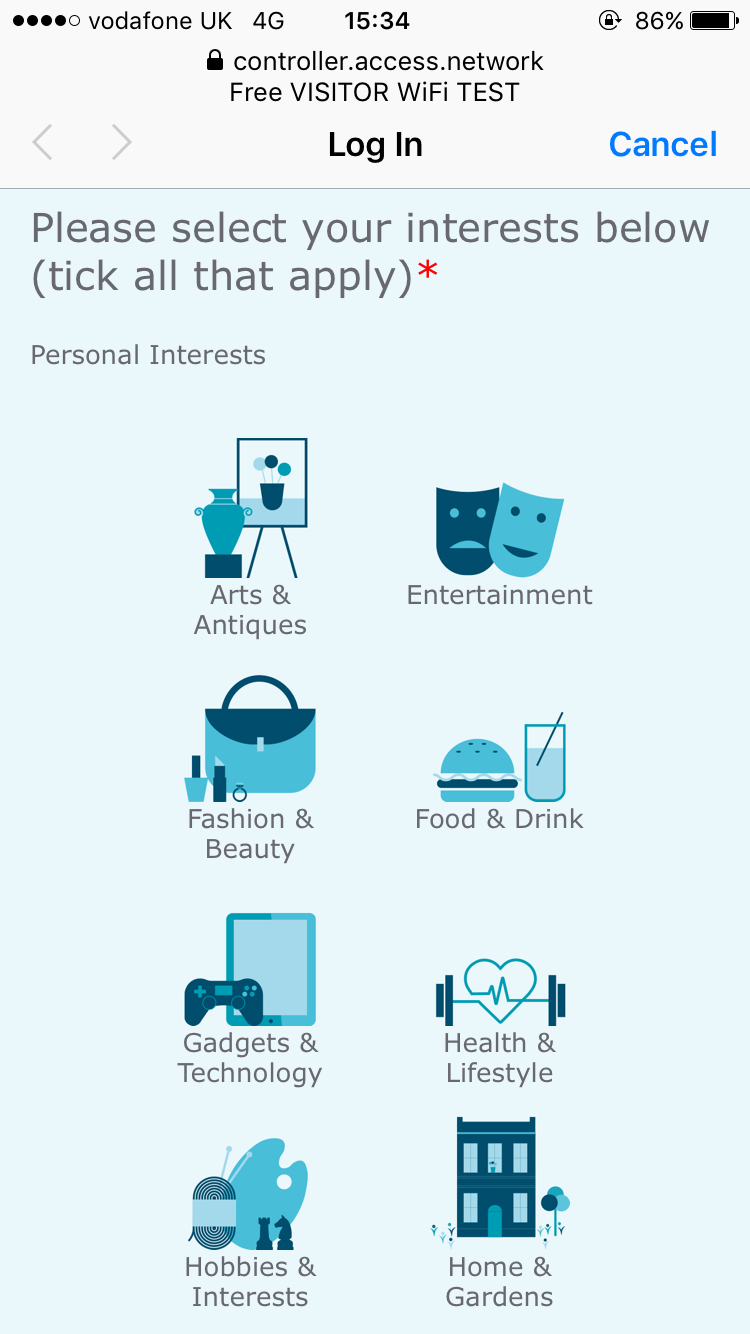
I wasn’t to be disappointed, as a spray-and-pray machine kicked in. Just to be clear, I’d visited to attend a marketing show and they knew this, although during the sign up process I had also selected the categories Music and (this is one category) Aerospace, Automobile, Marine, Public Transport & Defence.
I had done this for several reasons (I also didn’t give my correct date of birth as I don’t feel that’s appropriate to get wireless access), but mainly as, faced with so many options, anything to get me online quickly was good (mobile version left in part and the full experience on desktop). Why do I need to supply this level of detail to use the wifi at an event I’m attending? Why don’t you allow access and then find reasons (value exchange) to engage me further?
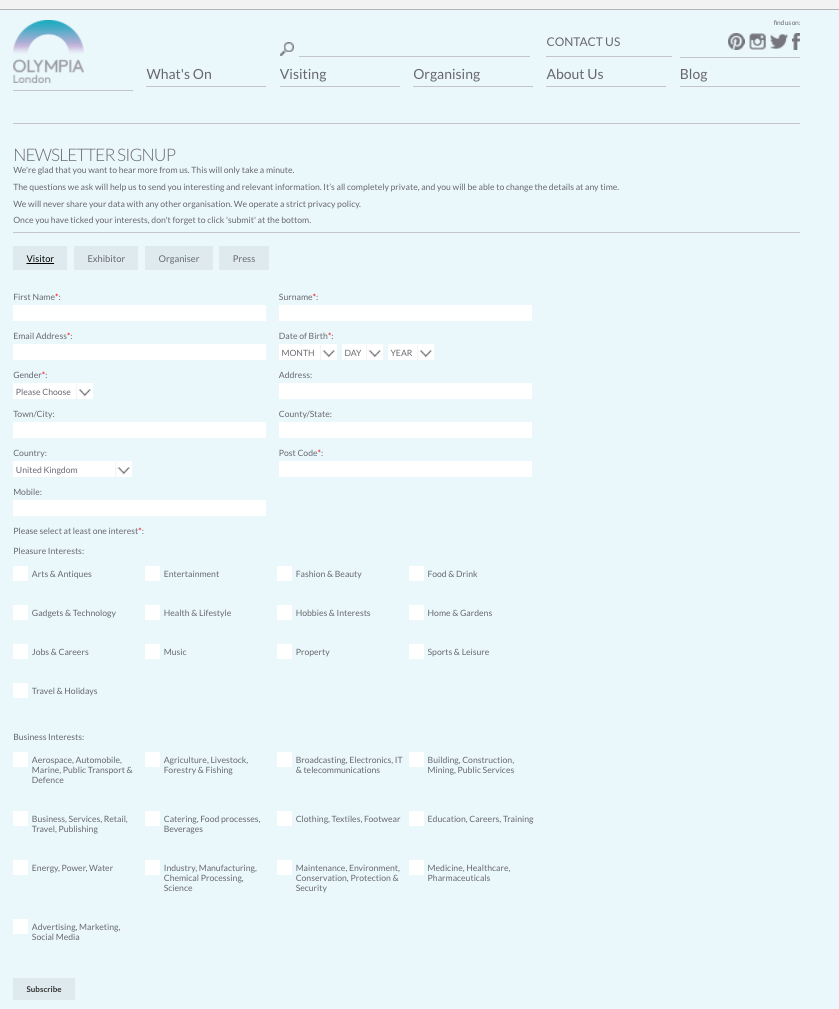
My first email (apart from the survey) was about bikes, presumably because I had selected Aerospace, Automobile, Marine, Public Transport & Defence. I guess, strictly speaking, it’s transport, but given it was on the business interests list, hardly appropriate. Perhaps it was because I work in marketing. Isn’t every marketer interested in cycling? Soho and Clerkenwell hippies that they are! Perhaps Olympia thinks so.
For clarity, there is a link to manage my preferences on each email. Very small, in the footer, and hardly encouraging me to do so, but if I had really wanted to I could have. I was having too much fun, though!
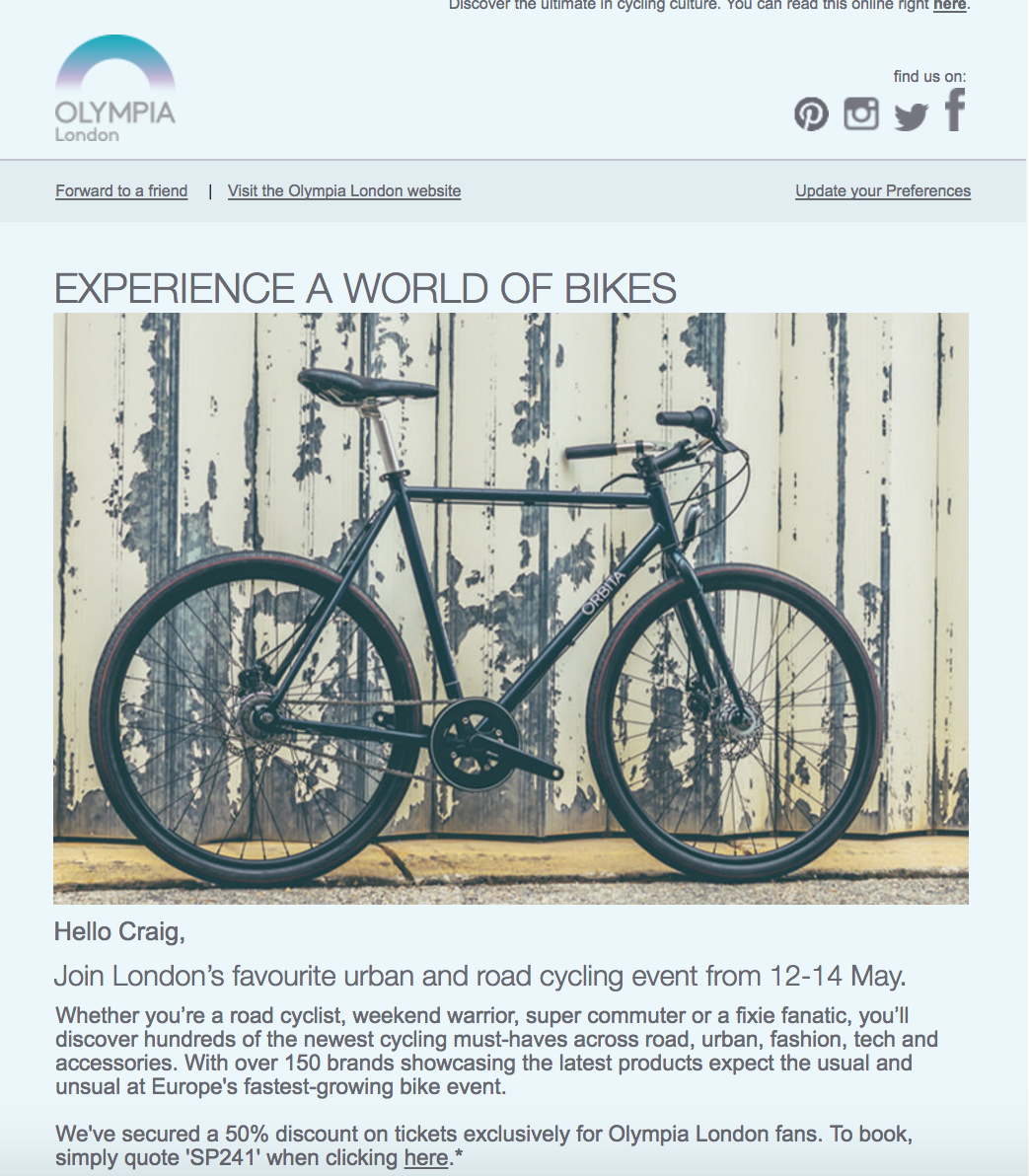
What I love about this is the line near the end that reads, ‘exclusively for Olympia London fans’.
Get over yourself! You’re a venue. We attend events. No-one is a fan of Olympia London!
A lot of marketers cycle, I’m sure, and there has to be a 20% chance that I cycle regularly. So, hey! Send me an email!
But next up . . .
A week later. No activity such as a click from me and it was time for another go.
Don’t like bikes, sir? You must be an electronics warfare man.
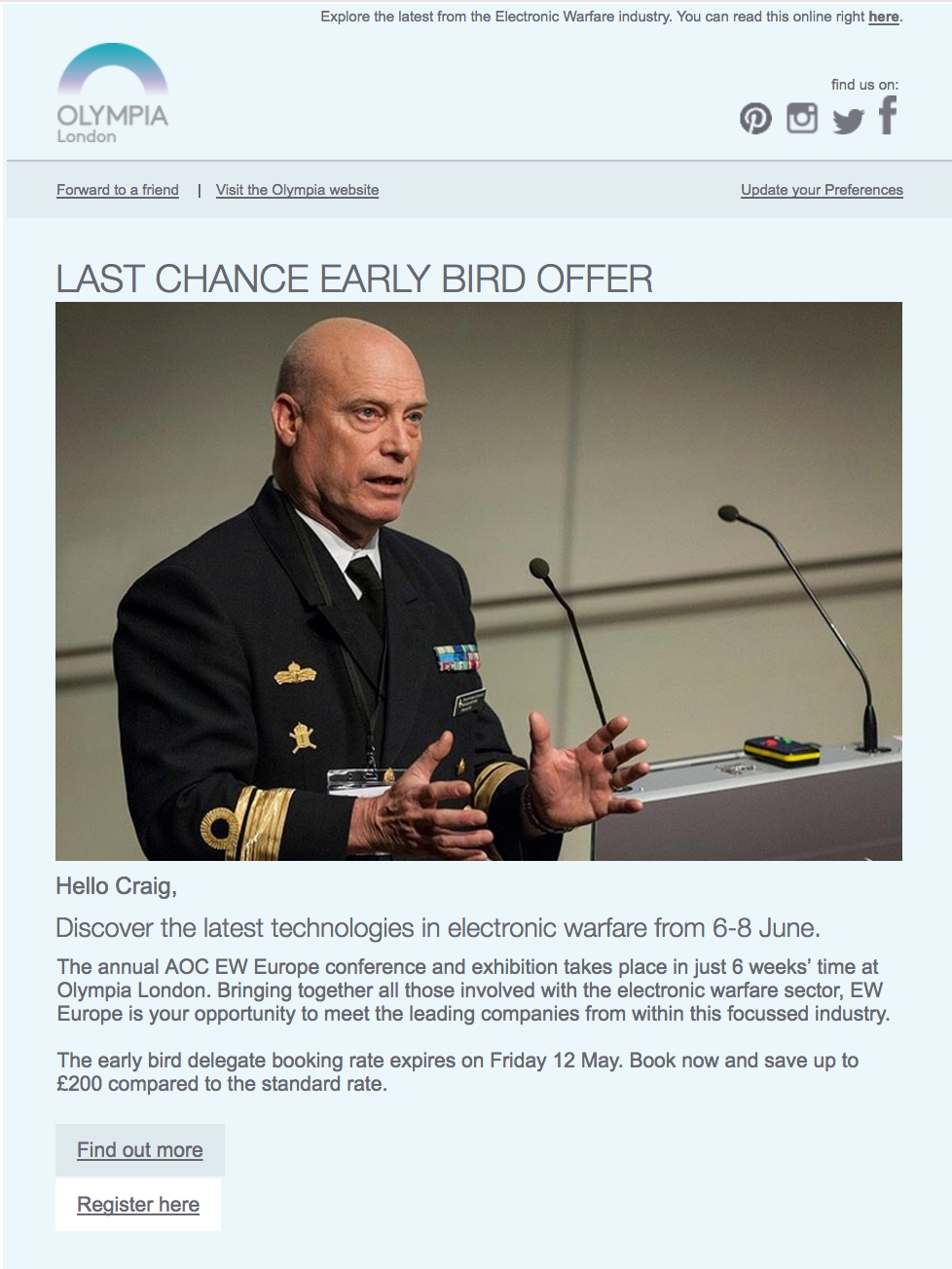
Yes, it’s that old stalwart on everyone’s diary, ‘the latest technologies in electronic warfare’.
‘EW Europe is your opportunity (YES, ALL MINE!) to meet the leading companies within this focused industry’
You even said it in your own email! Focused.
That means not everyone. Not marketers from Brighton, or cyclists from Clerkenwell or even aviation experts from wherever they come from. Certainly not someone forced to choose Aerospace, Automobile, Marine, Public Transport & Defence to get online (the detailed observers among you may have noticed that it was the first choice on the second list)
Although the execution of these emails is not great (design, easy link to preferences, easy opt out, copywriting, formatting, etc) there is a bigger underlying problem.
The assumption that, because you put a data wall in front of a user and something they want (or need) to access, that data wall is a long, long form with a lot of random choices around future topics, that this gives marketers an explicit right to keep contacting us.
Yes, I double opted in, too. But only because I was forced to in order to get the access I needed to make the most of the conference experience that is Olympia’s actual business.
To activate your Visitor WiFi, please click the link below:
https://controller.access.network/?user_ip=10.129.15.204&autoconnect=eHZnemd6Nw==&autoconnect_key=ce43f77b642a0ed51f4defefcc4234648daf16fb
Email targeting and personalisation: it’s no joke
While I make light of some of the issues, the point is serious. Email is a fantastic channel, widely quoted still by many marketers as having the best ROI outside of organic search. But it only works when it is used well. When we personalise and target. Just because we can send, doesn’t mean we should send.
GDPR is the start of legislators trying to get the marketing industry to get their ship in order. More will follow unless we really do. And consumers are getting annoyed; they are moving away from spam mail to private channels, taking with them a key weapon in the armoury of many companies. Only by ending this spray-and-pray approach can we hope to keep email relevant.
Send us your examples of email gone bad for potential inclusion in our series, ‘When email goes wrong’. Check out the first edition, here: Every communication matters.
Have an opinion on this article? Please join in the discussion: the GMA is a community of data driven marketers and YOUR opinion counts.
Read also:
It’s big, but it’s not clever – email overkill: retailers should stop the spam
Email research reveals need for dynamic marketing, relevant content