
However, at more than 200 pages, it’s a bit of a read – so here are the GMA top 11 takeaway takeaways for you! For those wanting to read the full report, you’ll find it here: Mary Meeker Internet trends 2016
1. Internet penetration growth is slowing
2015 year-on-year growth was 9% (same as 2014), but those figures hide some interesting data. India grew 40% to become the world’s second largest user market (behind China ahead of US). Smart phone growth and shipments also slowing (dramatically) as addressable market penetration is reached. Android dominating globally with 80% share.
2. Economic storm clouds, but short term and long term are forming
Slower GDP growth, higher debt (personal/corporate and government), highly leveraged commodities vs growth opportunities, ageing population as global birth rate falls, is creating a very risky business outlook (GMA comment – add the medium-long term climate costs and the picture is worse still).
Opportunities for businesses that innovate to drive efficiency, lower costs, create jobs AND tackle key problems. Digital enterprises are likely to be at the core of these.
3. Online advertising turns out to be like offline advertising
Online advertising is now dominated by a few big players in key markets (Facebook and Google have 76% market share in US) leading to old media problems of dominance and pricing.
Large advertisers still not very good at capitalising on the digital opportunity and have poor content/creative strategies and overspend on traditional media still when share vs spend is considered.
4. Millennial Power
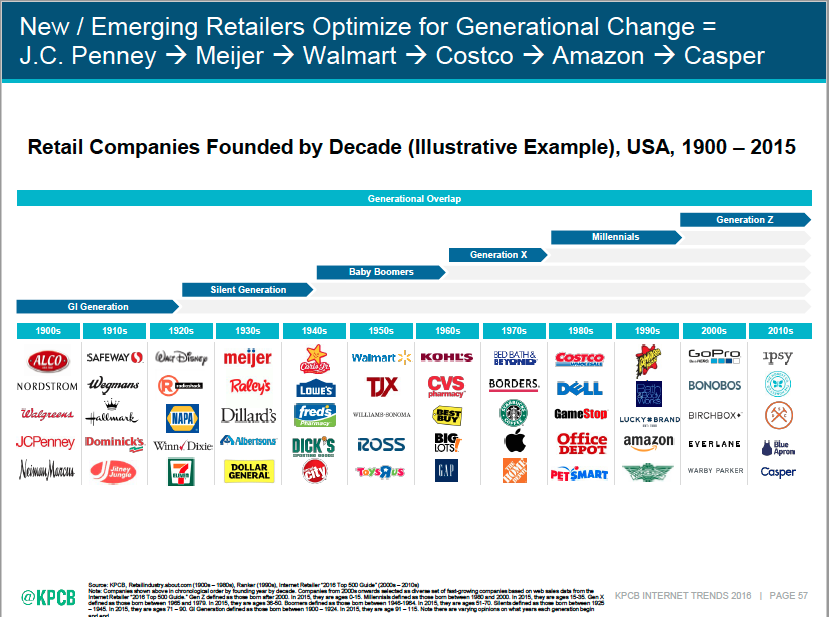
The long talked about Millennial generation is now actually worth talking about. Data rather than commentators shows us they are entering the age range when they will have the most spending power (and decision making power). Understanding this audience is key for any brand to grow. They index heavily to online retail and will drive continued growth in this sector. Traditional retailers who do not adapt will join the many other ex-retailers.
5. The visual web
The visual web (communicating with images and video) continues its meteoric rise with no end in sight as key players pivot to services where visual services are central. It’s also a move from static and on demand to live streaming.
There is now empirical proof that the visual web increases engagement and conversion, driving increased revenue, especially among retailers. Companies like Houzz are seeing large growth due to the ability to use visualisation tools to drive commerce in home retail sector.
6. Messaging services have become much more than well messaging services
The integration of services into messaging apps is well underway. Already we can see financial services, transport, streaming video, gaming, grocery delivery and many more. Platforms in Asia are leading the way (TALK in Korea, WeChat in China and LINE in Japan).
This integration and high adoption rates among younger consumers mean that messaging services should now be an essential part of any customer service offering. Millennial and Gen Y prefer this method of contact vs traditional channels such as telephone.
7. Human to computer interface is changing (and that’s a really big deal)
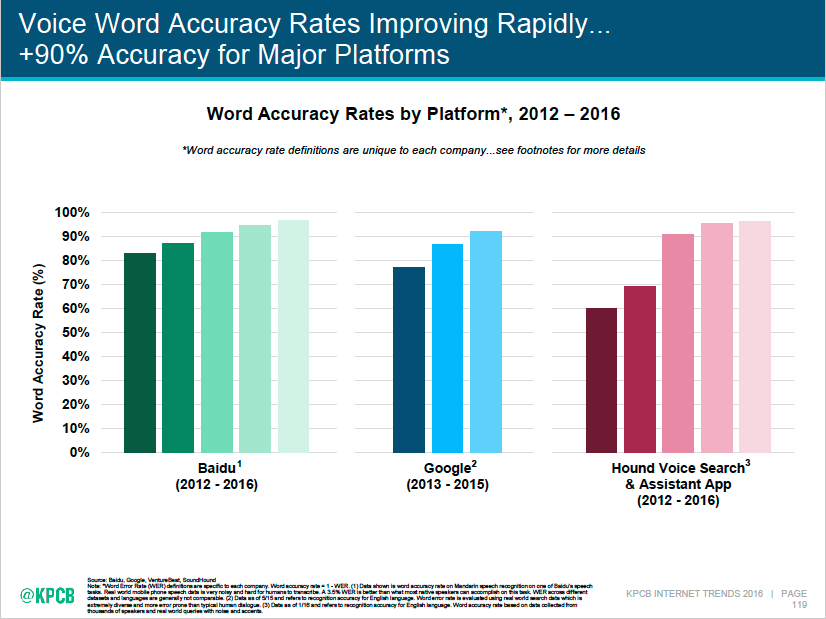
It is the beginning of the end for the keyboard as voice commands take over. Google has stated already this year that 10% of search queries are now voice (predicted to be 50% by 2020). Computing power is driving speed and accuracy. Other benefits include hands free, speed, low physical footprint (microphone vs keyboard), predictive. At 99% accuracy (which we are closing in on) we’ll all use it. Until them we use it for simple, repeatable tasks like “call mum”. Specialist devices such as Amazon ‘echo’ driving awareness and function.
8. Auto transport is being reimagined on all levels
A perfect storm of new business models (Uber), new technologies (electrification and self driving) and old school logistics (costs of ownership, commuting time wasted) are changing the future of road transport. Risks include poor/slow regulatory adaptation to new technologies. Opportunity to improve efficiency, reduce accidents, manage traffic loads, etc, as machines make better decisions than humans.
9. China changing
China is slowly but effectively turning into a more balanced economy with services growing much faster than manufacturing or construction. China is e-commerce first when it comes to retail with its leading retailers now e-commerce only and much more dominant than in developed markets.
Continued rise in disposable income driving services growth. China now the largest outbound tourism spending country in the world spending $165B.
It’s also leading the way with digital payments. WeChat integrated merchant payments now more than 50 per user, per month due to versatility (vs 20 for a debit card).
10. Incumbent companies struggling for growth, but betting on tech
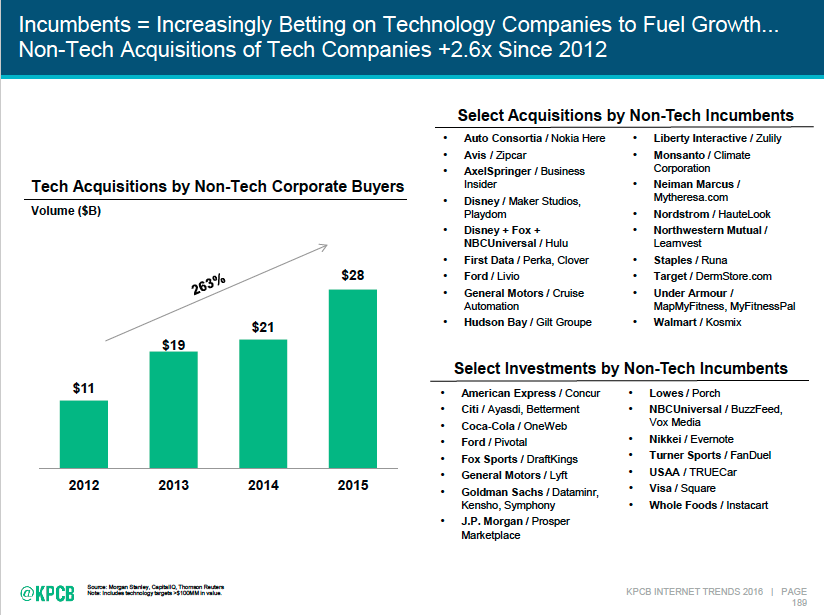
Traditional companies in most sectors are struggling to compete and grow. One strategy that is growing in popularity is to purchase tech companies with high growth. If you can’t beat them, buy them . . .
11. Data is a new growth platform powering new services and systems
Data in the digital universe is growing at 50% CAGR while costs are falling at 20% per year. New data sources are coming online all the time via IOT, Connected Cars, Digital Health Devices, etc. New opportunities for those able to harness, visualise, store, interpret, use data effectively. However the data explosion will lead to continued debate and legislation around data usage. Signs are that consumers want the utility offered by data usage more – likely to end up not what their data gets used for, but who has access to use it. If the value exchange is high enough, people will share data.
As always, there is more detail in the report but for those of you who are time-short, we hope this has helped get the main points into a ten-minute read.